
Podcasts for creatives
 We love podcasts here at Creative Women's Circle. The combination of narrative storytelling + in-your-ear intimacy + inspiring interviews makes podcasts the perfect medium for busy creative ladies. Stick your earbuds in and get a dose of creative inspiration while you are working, wandering or waiting.
Here are some of our faves...
Design Matters
Running since 2005, Design Matters is (probably) the world's first design podcast. Host Debbie Millman interviews designers, creators and big thinkers from Alain de Botton through to Lisa Congdon.
Must listen episodes: Amanda Palmer, Oliver Jeffers, and Chip Kidd
After the Jump
Hosted by Grace Bonney from design blog behemoth Design*Sponge, Grace and her guests give nitty gritty business advice on branding, the real cost of business and how to make the most of social media. They also dive into the inspirational and emotional side of creativity and business with talks on work/life balance, productivity, finding your voice and living the life you want.
Must listen episodes: Sex and the City designer Lydia Marks, The Hidden Costs of Independent Design, and 10 Habits of Healthy and Happy Business Owners
The Jealous Curator's Art for Your Ear
Behind-the-scenes info and news about talented contemporary artists. Host Danielle says 'You'll hear first-hand from these talented, successful, full-time artists (who also happen to be regular people with hilarious stories) BEFORE they’re in the Art History books.'
Must listen episodes: Lisa Golightly, Terrence Payne, and Erin M Riley
The Lively Show
The Lively show is a weekly podcast designed to uplift, inspire, and add a little extra intention to your everyday. Episodes touch on various aspects of our lives including possessions, personal habits, relationships, and career. Entrepreneurship and online business also appear from time to time.
Must listen episodes: My Top 10 Lessons From My “Lively Adventure”, Fulfilling Your Soul in a different, creative way & Impostor Syndrome with Jasmine Star, and How to take big + small steps towards a zero waste lifestyle with Bea Johnson
The Moth
Not about creativity per se, The Moth is a collection of recordings from live storytelling events around the world. It has been around for years and is full of hilarious, poignant and surprising observations.
Must listen episodes: The Lollipop Boy, Hitchhiking, Mosh Pit, and Iggy Pop, and To Bid or Not to Bid
Conversations
Incredible conversations with Australia's best interviewer Richard Fidler, these podcasts cover everything from history to science, celebrities to ordinary people. Conversations is released four days a week and features people from all walks of life.
Must listen episodes: Jon Ronson: public shaming in the digital age, James Earl Jones beat a childhood stutter to build a career on his voice, and Helen Razer champions rational thinking
The New Normal
Okay, so obviously we are biased as The New Normal is hosted by myself and CWC President Tess McCabe, but we chat to many excellent mothers about all things creativity, business and parenting. There's something there for both parent and non-parents alike!
Must listen episodes: CWC members Martina Gemmola, Annette Wagner and Julia May
Industry insights: Anais Lellouche, curatorial director
As I continue my Industry Insight quest to explore, discuss and spotlight the many diverse creative industries women are leading and making their mark in, I wanted to feature a career that has been on the my list of 'what I want to be when I grow up' for a long, long time: a curator.
Before speaking with Anais Lellouche, curatorial director at Anna Schwartz Gallery, I knew there was much more to being a curator than what Charlotte on Sex in the City alluded to.
Read on to share her insightful feedback on how Anais become a curator, what the role actually involves and five tips for how an artist finds gallery representation.
What lead you to become a curator?
I was very fortunate to have had a passion for art from a very young age and I started gaining experience in the field at the age of 16 years. I knew I would work in the arts but was not exactly certain in what capacity, whether as an artist, gallerist, in a museum, or auction house. So I tried them all! This is how I found my way; I kept moving ahead with experiences in the field until it felt right.
In a contemporary art environment, a curator is a person who selects and often interprets works of art. In addition to selecting works, the curator is often responsible for many other aspects, and it is by nature a multi-tasking role. What does your role as a curator at Anna Schwartz Gallery involve?
Anna Schwartz Gallery is a very special place, which has been the home for leading contemporary art in Australia for over 30 years. My role is to support artists in the presentation of their works, whether at the gallery, in museums or with other projects and commissions. The best part of my role is working closely with artists and external parties and to develop opportunities for them to create and exhibit their work. I am fortunate to work closely with the founder, Anna Schwartz, and to draw from her relentless enthusiasm and experience supporting artists to achieve their visions, with no compromise.
You recently collaborated with Chiharu Shiota, for her inaugural exhibition at Anna Schwartz Gallery and Public Art Commission of the Melbourne Festival. How did this collaboration come about, what was your role and do you have any recommendations for managing a creative collaborative process?
Jonathan Holloway, the Artistic Director of the Festival had been interested in Chiharu Shiota’s work for many years and since the gallery represents her, it was a natural collaboration. The articulation of gallery space and public space offered the possibility for the artist to showcase different parts of her practice and thereby reach a wide audience. Shiota’s projects were a real collaborative effort from the early stages, working with engineers to ensure that the 7 metre tall mobile home the artist wanted to create was achievable, all the way through to the students and volunteers who worked with the artist to create the installations.
My recommendation for managing a collaborative process applies to any other profession: trust your instincts, pay attention to detail and approach this role, not as a job, but as if it were your very own project.

Pictured, curatorial director, Anais Lellouche and artist, Chiharu Shiota. Courtesy of the artist and Anna Schwartz Gallery. Photo by Zan Wimberley.
Temporary exhibitions increase in cultural importance, just as the traditional role of galleries and museums with well known and established collections follow the call for ever changing exhibitions as well. What are the challenges of curatorial strategies when planning future exhibition programs?
Galleries support artists in the long term and our exhibition programs are more consistent as a reflection of this commitment. That being said, I am also animated by developing new relationships and dialogues for the artists we represent alongside other leading international artists; to exhibit artists for the first time in Australia and to support and expand the local cultural scene.
Can you provide 5 tips for how an artist finds gallery representation?
1. My first tip would be to develop a unique voice. To gain experiences in different cultural contexts, through travelling, but also through research, stepping beyond the local field of expertise and interest, to nurture an original approach.
2. Another tip would be to socialise and develop a networks of peers; to show your work; to discuss ideas, and to share a cultural life together.
3. Don’t be too eager to be represented by a gallery, it is preferable to be ready and to align the right match; this often takes time.
4. Believe in yourself wholeheartedly; because if you don’t, no one will.
5. And lastly, be resilient, and never, ever let go.
Annette Wagner is a designer, marketer, creative consultant, artist and writer. She is also on the board of the Creative Women’s Circle. Obsessively passionate about the arts and the creative process, she is determined to not talk art-speak and instead focus on supporting and sharing concepts and insights most creative types crave to know.
The 10 benefits of handmade
 By Emma Clark Gratton
In theory, we all know the benefits of handmade. The anti-globalisation catch-cry of ‘Think global, act local’ has definitely hit home, with handmade and craft-based micro businesses popping up everywhere. But the very real, tangible benefits of making, using and buying handmade products have an effect that goes beyond a simple business transaction. We’ve outlined ten ways that the handmade economy is a win-win for everyone.
For the maker…
Keep craft skills alive
Traditional skills such as crochet, macramé and embroidery have had a comeback in the past couple of years, despite few people actually needing these skills in the same way that we did 100 years ago. Keeping these skills alive and active is an important part of our cultural heritage, and worthy of support.
Spread joy
The reason why most people start handmade or creative businesses is because they are passionate about what they do. They love their work, and want to share it with the world. Buy handmade and support the spreading of joy and happiness!
Support the person
When you buy handmade, you are literally supporting a person, not a faceless corporation. The products might be made on the kitchen table in between school pick ups, or by a particularly creative lady who left the corporate world behind to make unique products. And the (small) profit they earn will go directly to them, not to line the pockets of some guy in a suit.
For the buyer…
More unique
You only need to look at the shelves of your local Woolies to see the range of products dwindling in response to cost-cutting measures. With out the ‘make this cheaper at all costs!’ impetus of most mass-produced industries, the handmade economy throws up way more creative, unique and customised outcomes. This diversity is of huge benefit to the consumer – mo’ money, mo’ problems (or something like that).
Better made
Again, without a corporation’s bottom line looming over every detail of a business, handmade products are generally much better made than mass produced goods. Plus, if something does break, the maker is usually more than happy to repair your product.
Fuller experience
A study researching cheeses in America found that consumers prefer buying ‘artisan’ cheese because they feel it provides a fuller ‘sensory experience.’ This is a factor of both intrinsic properties, like better taste, and extrinsic properties, like the joy of finding something you really love. Even just the knowledge that a product was handcrafted contributed to the feeling of a better experience because there is a relatable, knowable back-story.
For everyone…
Much, much greener
This is an obvious one, but buying local handmade products is a trillion times more sustainable. Less transport, less overheads, less waste. Work done by hand takes less energy than a mass production assembly line, which makes it more environmentally sustainable.
Support the economy
Studies have shown that locally owned independent businesses —many of which sell wares produced by hand— return a higher percentage of their revenue to their communities than the bigger chains. This means that by buying local, you are pouring money back into your local community, rather than the money heading off overseas.
Decreasing dependence on multinationals
Frighteningly, there are only ten companies in the world that own almost everything we buy. The same company that owns Pringles also owns Duracell, Hugo Boss and Oral B. Supporting handmade means sidestepping the global corporations, and securing our economy for the future.
Handmade is forever
There is a cheeky thing in the mass-market design world called ‘design obsolescence.’ This means that a product is built to fail after a certain amount of time, so the consumer will need to repurchase the product (I’m looking at you, Apple.) It is a relatively new phenomenon, which is why your nana’s Mixmaster is still going strong after 50+ years, while your new Breville broke after three years. After a few decades, this has created a culture of ‘if it’s broken, don’t fix it – just chuck it out’.
And this is where handmade excels - there’s no need for an upgrade as it is perfect already. And the nature of handmade products means that they will literally last as long as the materials will- so think of it as a good long term investment!
---
Emma Clark Gratton is the Head of Content at Creative Women's Circle, a staff writer at ArtsHub and a podcaster who, alongside her husband Lee, runs GRATTON, a timber furniture and architectural joinery company. She blogs occasionally at Worst House Best Street and posts endless photos of her sons on Instagram at @emmamakesthings.
How to hold an art exhibition
By Júlia Palazzo
I work in a studio with another artist and for the past month I’ve been helping him put together his first solo exhibition in Melbourne. I have to say I’m SO relieved that we had the opening last Friday and that all the work is nearly over! As much as having your own exhibition is an incredible experience, it can also be stressful and daunting.
If you are early in your visual art career, you will eventually want to showcase your work in your own show. And (at least at first) you will probably show your art in artist run galleries and more alternative venues, and will be responsible for a lot of the work related to making your show succeed or fail.
Here are 5 areas to keep in mind when creating an art exhibition:
Paint: Go on a journey with your art
When creating art for a show, pick a theme that you know you can explore for an entire body of work, that you are passionate and curious about. Write, think and study the concept behind it before you start creating the final art pieces. You should be able to describe the ideas behind your work concisely, and refer back to them when you feel lost.
Know how many pieces you’ll need to create for the show, and be realistic about how long you will need to paint them. Make sure you book the venue well in advance, and try to have all the art finalised a few weeks before the opening. You don’t want to be painting until the last day available and then have no one turn up because you didn’t do any promotion.
Choose materials that you are comfortable working with. Exploring and practicing with new mediums might be best left for when you are not under pressure to create work for a show.

Present: Use the space creatively
Measure the walls and choose how you’d like your art to be displayed in advance, making sure that you create enough art to achieve the result you want. Think about how people will walk around the room, and whether the order of the artwork can tell a story or take them on a journey.
Think beyond the art. How can you transform the venue’s space to create a remarkable experience for your viewers? Can you use the scent of flowers, music, or change the colours of the walls to help people immerse themselves in the art? Attend other exhibitions in your city to get inspired. If you are in Melbourne, Backwoods Gallery in Fitzroy always does an incredible job of presenting their exhibitions in an unexpected way.
Give people context. Did you go on a trip away or develop a new method to create this body of work? Think about how you can tell your story to people through the display, and prepare yourself to be able to talk about your art.
Promote: Spread the word through your network
Make sure that the design of the promotional materials and the photos of your art will do it justice. If the venue does not have a designer or photographer, consider getting one to help you.
While you are creating the art, post sneak peeks on your social media and remind people regularly about the upcoming event. Talk to the venue about creating a Facebook event and sending out press released to relevant publications.
If there are important people in your industry that you’d like to attend your show, do not be ashamed of inviting them directly through an e-mail or message. Ask you contacts to share the event with their peers.

Party: Make an event of it.
Plan an opening event to give people a chance to gather and meet you at your exhibition. Choose a date that won’t conflict with other similar events, and make the space pleasant through offering drinks and food. Many beer and wine businesses offer sponsorship and discounts for creative events.
Consider offering an artists talk on a separate date from the opening. This will give people a chance to hear about your work, and an opportunity to meet you if they missed the opening night.
Consider having accessible options for people besides the artwork. Not all you fans or visitors will be able to afford an original piece of art, but I guarantee a lot of them would be happy to support you and take home something from your exhibition. Maybe you can have an exhibition book, prints or postcards for sale.
Peace: Be in a good frame of mind
Look after yourself and your health during the process and make sure you SLEEP. Exhaustion will destroy your ability to make good art, and the last thing you want is to finally get to that opening event and be unable to enjoy it or talk to anyone because you are too sleep-deprived.
Be kind with yourself. It is perfectly normal when you are working on a big project to have moments when you feel that you are not a “real” artist or that your work won’t be good enough. Reach out to your friends or family for reassurance, and don’t feel guilty if you have to take a few days off to relax.
Keep the long term in mind. If you are a working artist, you will probably exhibit many times over the years, each one will be a step on your journey and a learning experience. Do not expect that one show will bring you overnight success, and do not be hard on yourself if at first you do not sell many pieces or get much of an audience. Stay positive, learn from your mistakes, and keep on creating.
Images by Michael Panozzo
Júlia Palazzo is a visual artist from Brazil. Since moving to Melbourne in 2013 she has been running a partnership, Mayfield Palace, creating mural art for businesses and organisations all over Australia. She shares her art daily on Instagram: @julia.palazzo
10 science-backed creativity boosters
 By Emma Clark Gratton
We’ve all had slumpy days where it’s hard to get out of bed, let alone come up with anything new. Luckily, the scientific world has proven tips and tricks to boost creativity.
- Clench your left hand
Doctor Amantha Imber is a psychologist and the founder of an innovation consultancy. "When we clench our left hand into a fist it activates a region called the extention memory system. So when this is activated it promotes more unique thinking. In studies, the people who were not squeezing or were using their right hand and not their left hand, didn't have as many creative thoughts. So if you clench your left hand you will have more creative thoughts just through that simple action," Dr Imber said.
- Meditate
If you are stuck on a certain issue and can’t move forward, it is easy to feel anxious and stressed. When panic strikes, try meditating: It promotes divergent thinking, a state of mind in which we’re able to generate new ideas.
- Write by hand
Carrie and Alton Barron, the authors of The Creativity Cure, advise us to skip the Word doc and pick up a pen instead. Sometimes the whole experience of writing by hand—the feel of the pen, the smell of a fresh notebook—is all it takes to get creative juices flowing.
- Look at something blue or green
According to the principles of colour therapy, the colours blue and green can promote creativity. Researchers say that’s because we associate blue with the ocean, sky, and openness in general, while green signals growth.
- Sit outside a box
Though it might sound a little strange, in one study, people who sat outside a box (literally) were better at thinking creatively than people who sat in it. No cardboard container handy? Try sitting in the hallway outside a room.
- Exercise
We all know the benefits of regular exercise, but even just a short walk can reset your brain enough to kick-start your creativity. Plus one recent study found regular exercisers performed better on creative tasks than their less active peers did.
- Be psychologically distant
Have you ever noticed that giving advice to a friend is easier than solving your own problems? This is because you are “psychologically distant” from your friend’s problem, meaning that the issue is not occurring in the present and does not affect you. According to a study from Indiana University, increasing the psychological distance between you and a problem boosts your creativity. You may also gain new insights and clarity by thinking about a problem more abstractly.
- Give yourself deadlines
According to a study by MIT Sloan School of Management, setting self-determined deadlines for completing a project improves task performance and decreases procrastination. Simply give yourself a set amount of time to finish a task, and impose on yourself incentives for meeting the deadline and consequences for failure.
- Think like a child
Picasso declared: "Every child is an artist. The problem is how to remain an artist once we grow up." But a recent study suggests that it's possible to regain the creativity we've lost to maturity. A few hundred subjects were assigned to two different groups. The first was given the following instructions: "You are seven years old, and school is cancelled. You have the entire day to yourself. What would you do? Where would you go? Who would you see?" The second group was given the same instructions, except the first sentence was deleted. After writing for ten minutes, the subjects were then given tests of creativity, such as inventing new uses for a car tyre or a brick. The students who imagined themselves as children scored far higher on the creative tasks, with nearly twice as many ideas as the other group. Picasso would be proud.
- Restrict yourself
Famously, Dr. Seuss wrote Green Eggs & Ham after betting that he couldn’t produce a story using less than 50 words. The research shows Seuss was on to something. Most people naturally take the path of “least resistance” and build off of older or existing concepts when brainstorming, which can lead to less creative ideas. In order to put the brain in overdrive, you can mimic Dr. Seuss and place restrictions on yourself while creating, which will prevent you from falling back on past successes. If you usually write 1000-word short stories, try to create a story in under 500 words. Only use a small handful of chords in your song or colours in your design. The limiting nature of the task can bring out your most creative side.
Emma Clark Gratton is the Head of Content at Creative Women's Circle, a staff writer at ArtsHub and a podcaster who, alongside her husband Lee, runs GRATTON, a timber furniture and architectural joinery company. She blogs occasionally at Worst House Best Street and posts endless photos of her sons on Instagram at @emmamakesthings.
Later.com for creatives
 One of the best assets we have for promoting our work and profile is social media. At a recent The Resolution Project event, this was illuminated when we had the opportunity to pose questions to a panel on any topic of current interest. Social media was a hot topic! The panel members Domini Marshall, Bec Mackey, Tess McCabe and Phoebe Miller (chaired by Madeleine Dore) offered great advice on how to manage social media, especially around content management. Many of the participants were intrigued as to how to best use their time, and how to manage building a profile with specific audiences.
"The best approach is to post two to three times daily to build your audience”
One of the best assets we have for promoting our work and profile is social media. At a recent The Resolution Project event, this was illuminated when we had the opportunity to pose questions to a panel on any topic of current interest. Social media was a hot topic! The panel members Domini Marshall, Bec Mackey, Tess McCabe and Phoebe Miller (chaired by Madeleine Dore) offered great advice on how to manage social media, especially around content management. Many of the participants were intrigued as to how to best use their time, and how to manage building a profile with specific audiences.
"The best approach is to post two to three times daily to build your audience”
- Domini Marshall
So I thought I would share my adventures into strategic social media management as I begin my new creative business and profile on Instagram. After the panel presentation, I was intrigued to explore platforms that would allow me to populate and schedule content. This is attractive to me as real time generation of content is not always possible. Plus, I’m very much looking towards productive strategies that can assist me in product and profile development planning and delivery. I went on a search, discovered that there are no 100% free platforms with all options available that offer this service for Instagram as yet, but there are plenty for Twitter.
What I did find was the platform Later.com. This is a platform that allows you to upload and schedule your Instagram posts from your mobile or computer. What I like about this platform is that is offers a free sign up option while exploring if it works for you. You can post image and text content 30 times in the month for free. This allows for the flexibility to capture spontaneous moments, as well as scheduled content.

Scheduling content for the week: desktop view
The platform sets up your week in a calendar format. This allows you to visually plan your time, and for you to post at the times that are ideal for your audience. This is where the wisdom of Kylie Lewis and Belinder Langler (of Of Kin fame) comes into play. Their research has indicated that you should be regular and consistent. Their work is also a great reminder to link into the digital patterns of most people’s social media habits of checking the first thing in the morning and in the evening before they go to bed. A great guide to when you can regularly post to build your profile.
A record is maintained of the content you have shared and how many times (stored in the ‘used’ section of the platform). And there is the opportunity to preload images for future content stored in the ‘used’ section of the platform. Once again, another benefit within the platform to support strategic management and smart use of time.

Creating content ahead of time
In planning your post you can add your image and caption. I think this is one of the best features of this platform to assist in content generation. The image and content can be added, then scheduled. This is then saved and ready to ‘pop up’ as a reminder to allow for posting.

Mobile application reminder on phone screen. This is a ‘pop up’ that serves as a reminder to post (transfer) the content already created into Instagram.
I have been approaching my content management by loading the images and captions of a Sunday for the week ahead. I have identified the times I would like the post to appear. By populating the content on the desktop I am dedicating my time to plan and consider how I want to share. This then connects nicely to my app, with an alert coming up on my screen.
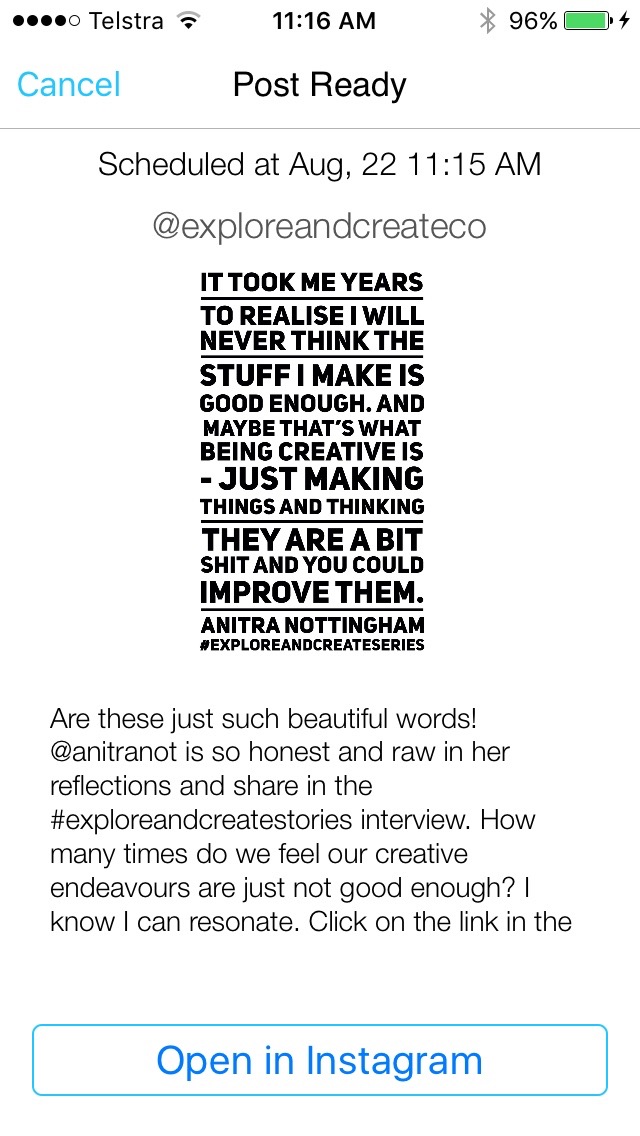
Later talking to Instagram to transfer your preloaded content.
Some thoughts in regards to the pros and cons of using a platform such as Later for Instagram as a summary includes:
Pros
- You can populate and schedule your content and pre plan for the week or month ahead.
- Can support you to think about your digital marketing strategy.
- Reminders are sent to your phone (once you have download the app) for the time and date you set the content to be launched.
- Can edit and proof read your populated content before you post. Perfect if you wish to add or change the content based on your thinking.
- An organisation helper.
- The app allows for sharing and posting on the go. Perfect for the creative juggling multiple tasks.
- Time efficient.
- Helps you forward think to align your posting to core values and missions as a creative or creative business.
Cons
- The content is created, however, it does not post it. You still need to transfer the content across to Instagram, however this is easy from the mobile app as it does a direct copy and paste for you with a few directed clicks.
- Must be connected to wifi.
How to open a store
By Jes Egan
Opening up a retail store is really exciting. Selling your product and other supplier's product is a real opportunity and can be lots of fun. There are a number of business related elements to consider when looking to open up your own retail store - here a few just to start.
Location, location, location
Location is key. Consider being in an area where you feel that your key customer segments are but don’t neglect to think about foot traffic as well. You want to be in a position where you may catch people walking past to come in and experience your store and all you have to offer.
Store size
When reviewing a new space for your store, think about the layout, where and how you’re going to set it up. Think about what stock you are planning to have and where you may put it. You need to ensure you have enough space for all of your stock but not too much at the same time. Also, keep in mind that your rent on the space tends to be measured by the square metre so if you don’t over stretch yourself getting space that you don’t need or that you can’t use.
Stock
How much stock do you need? Do you have a storage space that you can use for excess stock that doesn’t fit on the floor? If you have run your business from an online space in the past you may have an idea of the popular items that you need to have more of. If you are selling other business' stock, consider taking items on consignment or only ordering the bare minimum to begin with to see how they go.
Online
Don’t neglect your online store - many people see items in store and go home and order them online, plus it opens up your potential audience base outside of the area where your store is located. It is vital that you keep your store up-to-date with as much stock and information as possible, it can help build your brand awareness as well as reach.
If you don’t already have an online store, you can have a site custom built for you (which can be fairly pricey) or you can use on of the many eCommerce platforms that are already available to use, with templates, shopping cart functionality and check out facilities already built in. There are many out there, I found Shopify really easy to use.
Negotiate your lease
Leasing a commercial shop space will probably be one of your biggest outgoings, so take the time to think it through because if you find yourself unable to pay the rent it can put your business at risk. Review the average rents in the desired area and work out what is an achievable and reasonable amount to pay. Consider the length of your lease - if you are a startup, a shorter lease could be an option to consider. If the unfortunate thing happens and your business doesn’t go well then you’re not left with a long lease to pay or negotiate your way out of. It also will give you some flexibility if your business needs change and you need to consider a different space. A shorter term lease can cost more (monthly) than a longer one but something that should be considered.
Insurance
There are many different types of insurance that is needed such as employees liability insurance, public liability, WorkCover etc. Not all insurance companies offer it, a good place to start looking is GIO, AAMI, Allianz or Shop Insurance, Smart Business Insurance just to name a few! Speak to one of their consultants about what you are planning to do and what you will need. They can advise on the correct packages or if a tailored option is more suited to your needs.
Finance
Opening a shop is a costly thing to do! It isn’t cheap - you’ll need a certain amount of capital upfront to get it started. Consider things like rent, signage, point of sale systems, fit out, stock, staff, insurance, branding etc. Unless you have access to funds, you’ll need either an investor or a small business loan from a bank and you will most likely need some of your own capital to get started. Generally to get a bank’s financial support, you will need a solid business plan to secure the funding. Some banks' small business departments will help you with this plan. Make sure you don’t forget to account for paying back this loan as part of your plan. Also don’t borrow more than you need as you don’t want to be down the track with a big loan that you can’t pay back. Go and see a financial adviser or small business banker to give you the right advice for your business.
Promote
Promote your store! Advertise and market it in the best way that you see fit. Remember social channels are a great way to get your message out there, just remember you don’t need to be on all of them, chose a select few that your customers will relate to and do those ones well. Posters, door drops and offers for the local community are a great way to get your store out there alongside traditional and paid advertising.
There are many fun and exciting aspects to opening a store, the above are just some of the more boring but necessary things to consider on your path to opening something brilliant.
Jes is a ‘practical creative’ and a very busy lady, doing the business in a digital agency, being an artist and an university lecturer. Follow Jes on Instagram.