
How to give an amazing talk: Part 1 - the killer visual presentation
 By Jes Egan
So, you’ve been asked to give a talk to an audience on a topic that you’re somewhat of an expert in (even if the topic is yourself and your career/business!). Congratulations! Speaking publicly may strike fear into the hearts of some, but for those who want to overcome this hesitation or who simply love engaging with a captive audience and sharing your story, I’ve composed this two part series to make your talk even more amazing.
While the ‘talking’ part of the talk is a given (I’ll go into this in more detail next month), what is optional is a visual presentation to highlight key sections, underline points, and generally give the audience something else to engage with. But, you can’t just create a visual preso ‘off the cuff’ - it requires careful preparation and planning, even if your presenting style is more freeform on the day.
What is on your slides, paper, boards, or whatever it is that you are presenting from, can be simple but it needs to be considered. Here are my top tips for designing a killer presentation.
1.Text on screen: Less is more. This is personally my biggest bug bear, but also one that I have been guilty of in the past. When putting the presentation together, it is very tempting to put every single word you want to say as copy on the slides. But often times this distracts your audience from what you are saying, given that they are trying to read and listen at the same time. This practice can even lead you down the path of simply reading your presentation from the screen. Use a text slide to highlight the topic or key phrases, and if you are worried that when you leave your audience won’t remember what you said, consider summarising via a flyer, emailable presentation file, or other takeaway item.
2. Images are your friend. Images and infographics on screen can replace words in many instances. Heard the saying ‘a picture tells a thousand words’? For a killer presentation, it is true. Find relevant imagery that helps communicate your story, and let the image support what you are saying while your audience listens to your words.
Infographics can be a creative way to present information/data in an attractive visual format, and it can make it much easier for the audience to digest information that might otherwise be technical or dull. There are many online applications that will assist you to create infographics. Using these where you can keeps your presentation interesting and visually exciting without losing the integrity of the information.
3. Don’t overlook the basics When putting together a presentation, some basic things can be overlooked, but they may be crucial when the purpose of a presentation is to pitch for a job or represent your brand in its best light.
- Spell check! If the program you are using to compile your presentation doesn’t have a spell check option, simply copy and paste the text into a program that does and fix errors where required. Don’t forget to double check that the company or client’s names (if they appear in the presentation) are spelt correctly. It’s a rookie mistake but often overlooked, and these types of errors are unfortunately more obvious on the big screen!
- Name your sources. If your presentation includes any statistics, quotes, images or content created by a third part, be sure to give due credit or ask permission from the source. Name it, either on the relevant slides or at the end of the document. Don’t claim it if it is not yours.
- Check the presentation file loads correctly on a third-party computer, and have a backup saved somewhere else with you when you go in (e.g. on a USB stick or online). Make time to ensure the equipment at your presentation location is able to handle your presentation file, and test it (with time to make changes, or come up with a plan B if necessary).
- Consider adding slides that ‘Open’ and ‘close’ the presentation, to make sure your audience know when you’re done.
Finding the balance between what goes in the presentation slides and what you say can be difficult, but spending a little time to consider these things can make for a stronger and more successful presentation. Plus, feeling prepared can help to make you feel more confident for when you get up and present.
Stay tuned for my next post in September, where I’ll cover things to consider when you actually get up to speak!
Jes is a ‘practical creative’ and a very busy lady, doing the business in a digital agency, being an artist, a university lecturer, and small business owner who can creatively be found cutting up a storm at paperchap.com. Follow Jes on Instagram and Facebook.
How to design your own creative workspace
 By Diana Scully
I was never much of a desk or office person. In my previous profession as a lawyer, I had the opportunity to work at a communal desk and then was later given my own private office. While I do enjoy working in a quiet environment, attending the same location/room/chair each day was a challenge for me. So it’s no surprise that having now moved out of the corporate world and running my own interior design studio, the opportunity to work where it suits me best, is such a benefit to me.
While I still have my own office, where I get to display, decorate and style my own way, I don’t have to confine myself to this location, every day. Luckily for me, my role as an interior designer means I’m not always designated behind a desk, so I embrace the opportunity to mix things up and find spaces that give me the freedom to work at my greatest capacity and feel creative.
Transitioning from a practising lawyer into an interior designer, I have learnt how how to set up my work environment to maximise my ability to think and dream creativity for my clients. In this two-part series, I will share with you how you can adapt your environment to give yourself the opportunity to maximum your working capacity and allow yourself to be creative. In my following post, I will interview other creative women from Creative Women’s Circle to see what others are doing to inspire their creativity. Hopefully, during this process, you will gather some inspiration to covert your workspace into an inspiring, creative one.
Think beyond the desk
I think we’ve all learnt to believe that you are most productive when you sit at a desk. After all, for many of us, going to work means sitting at your workstation in an office environment, right? Not necessarily. Some of my best work has taken place in my favourite cafe with my headphones on, in the local library on one of their many armchairs with my feet up, or even taking my meeting calls as I walk through a city park or stroll along the beach. After spending the last year in LA and not having a designated workspace, I’ve learnt that I can equally if not more so, be productive at locations that make me happy and accommodate my needs (i.e. internet access). So think beyond the office desk and immerse yourself in various environments to allow yourself to think differently.

Your space is an extension of you
If however, routine, consistency and organisation is what you need to work productively, then a designated workspace may be the winning formula for you. In that case, before you set yourself up and run down to the nearest office supply store for your standard desk and chair combination, reconsider your space. Why not create an environment that makes you feel excited to come to everyday?
A few ways to avoid working from a typical workstation:
- Choose an unconventional desk chair - maybe a favourite armchair or dining chair? Or set up a few different seating arrangements in your space like a bean bag or sofa.
- Bring in your favourite table lamp or floor lamp.
- Choose a dining table for a desk and use boxes, crates, baskets and bedside tables as alternate storage options.
- Create a vignette of little pots in one corner of your desk, filled with greenery to offer you constant energy throughout your working day.
- Avoid bare and blank walls by hanging up your favourite prints or posters to keep you motivated and inspired.
- Place a sheepskin rug at your feet to keep you cosy and warm at the desk.
- Be adventurous with colour and paint a wall in another hue, or for the bigger risk taker, introduce some wallpaper!
Co-work spaces and four-legged friends
Last year, in LA, I spent some time in a co-work space in Santa Monica. Not only was this space a breath of fresh air from the stagnate interiors of the corporate world, it was an opportunity to meet new people, each doing their own thing. A fabulous place to network, discuss and explore your ideas with like minded attitudes and work in an environment that was comfortable, relaxed and free from rules and systems. Plus, most co-work spaces allow you to pick and choose the days you want to come in - so there’s no on-going commitment!
One of my favourite perks from working in this LA co-work space was it allowed guests to bring along their dogs for the day. This was such a delight! I instantly felt more relaxed and comfortable in my unfamiliar surrounding with a furry friend at my feet. Generally, dogs were well behaved, even as they roamed the hallways or nuzzled their noses into your legs, begging for their next scratch.
If you are lucky to have a gorgeous four-legged friend, next time consider taking him on a walk on your next meeting call or to sit beside you when you work from your laptop at your favourite cafe. I found that having a dog near by helped me keep calm and relaxed during my work day and a good excuse to take a break and pop outside for a walk.

Look inside then look around
To maximise your creative energy each day, you need to understand what sort of environment you work best in. Be open to exploring different locations like a home office, co-work space, local library or cafe and if it suits you, don’t restrict yourself to the same space every day. Give yourself the opportunity to explore new surroundings in hope to encourage you to think a little differently. For some of us, who thrive on routine or require a point of reference for work, don’t limit your environment to a mundane, boring space. Avoid conventional furniture arrangements and use unexpected pieces that will help you create something special. Be passionate about where you work! Setting up a workspace that makes you feel comfortable, as well as address your business needs, will no doubt keep you feeling creative and excited about what you do. Choose to create a space and find a location that reflects who you are. After all, how you work and play is a representation of your business and brand. Embrace this to design a space that is an extension of you.
Interior Designer, Diana Scully owns and operates her own interior design firm, Spaces by Diana that’s all about designing beautiful, personalised homes to reflect the people who live in it. Diana also has her own lifestyle blog, Spaces + Places, where she regularly writes about inspiring spaces to see and visit from around the world and shares her recent travel adventures. This year she has plans to spend time abroad in the US. Follow Diana on Facebook,
Accounting tips for your creative business
 By Monica Ng
One of the biggest challenges for creatives can be understanding and keeping up to date with the accounting side of their business. Understanding the numbers in your business is a vital skill that can remove much of the guesswork when you make decisions regarding the profitability of your work. When you have access to real data and can identify concrete trends across the profitability of the products and services that you offer, you can make decisions based on real information, not just a gut feeling.
As a jewellery maker and designer myself, I completely understand that managing the books can be a difficult and tedious task, because before I changed to a creative career, I was working in the accounting industry. So today I want to help you gain a better understanding of your numbers and the areas where you generate the most and the least amount of money, by explaining two must-have 'business report cards' and guiding you through how they can assist you to monitor and assess your business profitability.
1. Profit and Loss Statement
Your Profit and Loss (P&L) statement shows how your business performed during a period of time. There are three main factors of a P&L statement:
Revenue: Any sort of income you earn, whether it be from sales of products or services, commission etc; and
Expenses: Any sort of expense you spend in the course of running your business like:
- Cost of goods sold
- Supplies and materials (raw materials you use to make your products – fabric, beads, glue, metal etc)
- Rent
- Advertising (Facebook ads, Google adwords, marketing materials like business cards, post cards etc),
- Fees and charges (online shop fees, PayPal/credit card transaction fees, bank fees, EFTPOS fees, website hosting fees, stall hire fees, consignment fees)
- Office expenses (stationery, printing)
- Subscriptions (magazines/journals related to the industry your business operates in)
- Postage
- Utilities (electricity, gas, water, telephone, wifi)
- Insurance (home and contents, theft, public and product liability)
- Professional services (legal, accounting)
- Repairs and maintenance (equipment your business uses)
- Wages, superannuation etc.
(Please note this is a example of the kind of revenue and expense items a typical business may have - yours may vary.)
COGS (cost of goods sold): COGS refers to the costs directly associated to the production of a product. This includes any material costs, labour, shipping and other costs to transform the product to be ready for sale. Determining the COGS can be one of the more difficult things to calculate and the value changes depending on which valuation method you use when you’re doing your books. But to explain the concept simply, let’s go through an example. Let’s say, I have $100 worth of beads in inventory at the beginning of the month. I buy an extra $20 worth of beads during the month and have $50 worth of beads at the end of the month. How do I calculate my COGS?
(Beginning inventory: $100) + (Purchases: $20) – (Ending inventory: $50) = Cost of goods sold: $70
For more information or assistance developing your specific COGS, have a chat with your accountant!
Now here are some key formulae for a P&L statement:
- Revenue – Cost of Goods Sold (COGS) = Gross profit
- COGS = opening stock + purchase – closing stock
- Gross profit – expenses = Net profit/net loss
Remember to keep receipts for EVERYTHING you purchase, whether it be offline and online. For online purchases I like to save each receipt into a specific folder on my computer (and I also back it up regularly). You might prefer to print out your receipts and keep them organised in folders dedicated to a single month or specific financial year.
2. Balance Sheet
Your business' balance sheet shows your assets, liabilities and owners equity as at a specific date.
Assets: Cash, accounts receivables (money you have invoiced your clients that you have not yet received), inventory, investments, tools and equipment and any other asset your business owns
Liabilities: Money that your business owes (you have been invoiced for a service you used and have not yet paid or materials you have bought but not yet paid for), accounts payable, bank/credit overdraft and any other debt
Owners Equity: Anything that is left over, once liabilities have been paid for from assets. If your equity is high, it means that your assets outweigh your liabilities, if your equity is negative, you’re losing money, and your business isn’t making enough money to carry the level of debt it’s carrying.
The basic accounting equation for a balance sheet is: Assets = Liabilities + Owner’s Equity
Ageing receivables and payables.
If you sell products or services, you’ll need to keep a track of the ageing of receivables and payables. Ageing is usually broken up into four categories: 0 – 30 days, 31 – 60 days, 61 – 90 days and 91+ days.
When you issue an invoice to a client or customer, the longer the invoice goes unpaid, the higher the likelihood that you may not get paid at all. It’s important to monitor invoice payments, so you can chase up a client if the invoice becomes overdue. A debt is said to 'go bad' when the client doesn’t pay or can’t pay, which may mean you need to write it off as a bad debt. Not getting paid is certainly not good for your business!
Other useful accounting tips
Set up a dedicated bank account
It’s a good idea to set up a dedicated bank account for your business. Therefore, whenever you update your financial information, you don’t need to wade through all the transactions to pick out the ones that are personal and which ones are business-related transactions.
Let technology help your keep track of your data
There are lots of techonology options to help you manage the data your business sales generate, so you can turn it into information that’s accurate, relevant and timely for decision-making. If you’re just starting out or your revenue and expenses are quite straight forward, you could use something as simple as an Excel document to keep track of everything. Otherwise, cloud-based accounting software such as MYOB, Xero or Waveapps offer a host of benefits - though some might incur a monthly fee (but most have a free trial period so you can see if the investment works for your business needs).
Make accounting part of your weekly or monthly routine
Depending on the level of activity your business generates, you should update your financial information weekly or at least monthly to give you a good indication as to how your business is performing. Choose a day or even half a day each week/month, and dedicate yourself completely to managing and reviewing your P&L and balance sheets. Remember, this day is important to spend on your business and not in your business.
Do your own books (or at least keep a close eye on them!)
When you’re just starting out, I totally recommend you do your own bookkeeping so you can understand what is happening in your business, rather than outsourcing it straight away to a professional bookkeeper or accountant. As your business grows, and your business generates more activity, it may be worthwhile bringing on a professional to assist, so you can concentrate on the things you do best and provide most value to your business. Bu having said that, even when you have outsourced these tasks to other people, it’s still important that you understand the accounting and continue to review the numbers from month to month.
Get started today
If what you've read sounds great, but still a little overwhelming - never fear. Over at my website I’ve created a customisable P&L template for you – so you can use this immediately for your business! The template contains instructions to guide you. Try it out and I'm sure you'll get addicted to how knowing how your business is going financially. Happy accounting everyone!
NOTE: This article is intended as an EDUCATIONAL GUIDE ONLY and is NOT INTENDED to be taken as specific financial advice. Please discuss your business' financial performance with a qualified accountant, solicitor or financial advisor.
Monica Ng left her accounting career at the end of 2013 to run Geometric Skies, her Etsy jewellery business, alongside her jewellery and object design studies at the Design Centre in Sydney. Find Monica at her blog or on Instagram @geometric_skies.
How to work from home with kids
 By Emma Clark
The ‘juggle’ of working motherhood has become a bit of a cliché, but when your days involve filling sippy cups while simultaneously emailing clients on your phone and trying to stop a baby chewing through your laptop cord, it certainly does feel like a circus.
As I've mentioned in previous posts, my husband and I run a handmade furniture business together, so we use a combination of grandparents, crèche and flexible work hours to care for our two young sons. This works well for us at the moment, but the wheels often fall off and I regularly find myself needing to work from home while the kids are around. It can be a challenge – there’s been plenty of of nappy changes on meeting room floors and client calls while playing Lego, but I’ve managed to come up with a mish-mash of solutions that work for our family, and may work for yours too!
Get a routine By routine, I don’t mean a steadfast, inflexible schedule. Just having a regular order to your day makes things much easier for you and your kids. Having a routine helps kids feel secure, and helps you feel like the chaos is at least somewhat under control. I usually try and get any errands or kid’s activities done in the morning so I know we can be home for my youngest son’s afternoon nap. Speaking of naptime…
Naps are sacred There is no one as productive as a parent who is working during a kid’s naptime. Having a time limit on your work can make you super-efficient and forces you to concentrate. I sometimes manage to complete as much work in the two hours that my son is napping as I could in a whole day of being in the studio. You can save up any phone calls, designing or work that requires your full attention for those magic hours. Grab a cup of tea, scribble out a list, then power through it. Try to avoid any distractions (ahem, Instagram) and hammer out as much work as you can in that time.
Embrace technology This is obviously a personal decision, but popping Play School on the iPad keeps my older toddler occupied while my younger one sleeps... and I can get some work done. Watching TV or playing with an app can also save the day if you need to take your kids to a meeting, or make an important call that you can’t be interrupted for.
However, technology can be a double-edged sword. Being able to get your emails on your phone at the playground or order materials online while pushing a pram is a lifesaver for many working parents. On the flipside, it can be hard to constantly switch from building a block tower to emailing a client, and you can end up feeling like you are not really present either with work or with your kids. Setting limits is a good idea, for your own sanity and for your kids. I try not to use my phone in front of my little guys unless it’s really necessary.
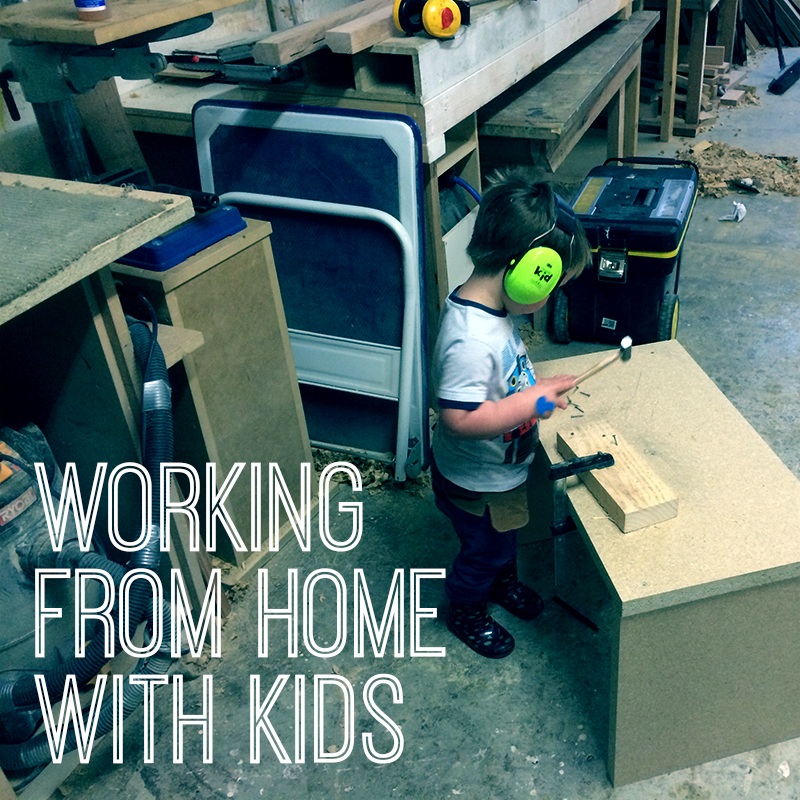
Recruit apprentices Depending on what kind of work you do, you can let your kids ‘help’ you work. This is particularly great for any kind of hands-on creative work. My older son has a mini workbench set up at our furniture workshop and can happily spend hours hammering away. If you are working on a computer, give your kids some pens and paper so they can ‘work’ too. Office supplies make awesome toys! A stack of Post It notes, a highlighter and a holepunch can easily entertain a toddler for enough time for you to get some work done.
Be creative Sometimes, no matter how organised you are or how independent your kids are, you have a deadline and you really just need to work. This is when you can get creative and call in back up. Ask a friend to hang out with your kids for a couple of hours so you are free to work (and return the favour!). Take your kids to the playground and explain that you are going to make phone calls while they play. Work from the library or a café on the weekend while your partner takes over kid duties. A photographer friend of mine takes her kids to an indoor playcentre with free wifi so she can edit while they run around for a few hours. Like everything to do with parenting, no one solution will work every time, so it’s a good idea to have a few back up options.
Relax No matter what you think of Disney’s Frozen, sometime you do just have to “Let it go, let it goooooooo!” Your house will probably be messier than usual, you might not get as much done as you planned, and your kids (and you!) might still be in pyjamas at 3pm. That’s okay. Nobody is a perfect parent, and nobody is a perfect creative business owner. Working from home with kids is hard work, so embrace the chaos and remember, tomorrow is a new day.
Emma Clark is an interior designer, writer and podcaster who, alongside her husband Lee, runsGratton Design, a timber furniture and architectural joinery company. She blogs at Worst House Best Street and posts endless photos of her sons on Instagram at @emmamakesthings.
Learning from mistakes
 By Jes Egan
I’ve made some errors in my career, believe me. Some of them I’ll call mistakes; some of them I’ll call a steep learning curve that took many directions (not always upwards); and others I’ll blame on my madly creative upbringing (at least one of them has to be someone else’s undoing!).
Although at the time most of these mistakes were either painful, stressful, financial or just pure embarrassing, I don’t look back at them in as much horror as I probably felt at the time. Because making mistakes aren’t always a bad thing. Yes, the dictionary definition of a mistake is something misguided or wrong in the context of what it was intended, but that doesn’t mean you can’t learn from them. Maybe, just possibly, a mistake can that intention into a new (maybe better) direction or as a result you might simply know what to do differently in the future.
Mistake: not understanding a creative brief Lesson learned: let the experience go and re-do the work (paying careful attention to the client’s needs/wants this time and next)
Perhaps you have spent hours (or days) working on a project, to then sit with the client and realise before anything is said that you’ve made a mistake in the direction or misunderstood part of the brief, and that it’s back to the drawing board. The heart sinks, the fear pops it’s little head up, and then there is the frustration of ‘I should have asked this question/not assumed that/clarified their needs’. I’ve done this enough times now to know that these feelings, although totally genuine at the time, will pass and I’ll get something out of this experience in the future. I will think about it again, in time, when I’ve processed and I will learn from it. Sometimes an experience like this lead you somewhere you may never have got to before and sometimes it’s just extra work (that you will have to do. For free.). My importantly, hopefully you learn how to better understand a client’s wants and needs for a project before diving head first into the solution.
Mistake: under-quoting for a job Lesson learned: ensure your quotes are always detailed and that the client is aware of what is covered and what is not
I know that I’m not the only one who has made mistakes when putting together a cost estimate for a job. Simple things, such as not including enough detail about the tasks to be completed, or quoting a ‘fixed price’ and not telling a client when they increase the scope from the original brief the price will increase. These are easy mistakes to make. (Once, when I was starting out in the advertising industry, I was tasked by my boss to put a quote together. Before sending it to the client, I consulted with a senior member of staff to check the numbers added up and that there was an appropriate amount of detail. The thing I didn’t explain to the staff member who kindly checked it was the full brief detail, which I also didn’t put it in the quote. The next day my boss told me the quote I had sent should have been closer FIVE TIMES what I had estimated. Way off track. Fortunately for me, I had a great boss – and client – and they agreed to let us resupply the quote that better reflected the project brief. Phew...).
This is where a mistake can put you in a poor (or even dire) financial position. If you work for yourself, this is often the part that can hurt the most. As I’ve written about before, when it comes to quoting, the devil is in the detail: be very clear about what is included and not included in the cost, it allows you to more successfully negotiate more when it is needed.
Mistake: Saying something silly Lesson learned: It’s good to have a laugh at yourself sometimes!
A few years ago now I was sitting in a big creative ad agency meeting. There was much discussion and different ideas flowing, everyone was on a different page. To end the meeting and action everyone into gear (as was my job), I said, quote, ‘Let’s all go and get our pigeons in a line’. To which everyone went silent and the copywriter (naturally) said, ‘Jes, I think you’ll find it’s “let’s go and get our ducks in a row”’. Yep. That was where I was trying to go with it.
I am notorious for getting my metaphors wrong and just as I think I’ve got them all straight, I let another doozy slip and there I am again, back to the beginning. (That one I’m going to connect to my madly creative upbringing, because I heard a family member do just the same thing recently, to a metaphor that I have in the past been corrected on, and it made me smile).
Mistake: Making an error in your creative work that can’t be ‘undone’ Lesson learned: Adapt to the change in direction and see where the work goes from there
These days, my creative work sees me spend many hours cutting intricate designs out of paper. While I try to me methodical (and careful!), in the past when I’ve cut something vital out of a work, instead of a total ‘re-do’, I ask myself – ‘Did anyone else know that was supposed to be there? Nope? Well, what they don’t see they won’t miss”. I always continue with what I’m doing and find a new / different direction, which might not be what I initially intended, but I’ve found that being adaptable is sometimes creatively more challenging and rewarding at the end. However the nature of a commission means there is certain expectations, and this if I make a mistake is when my perfectionist self will kick in and it is a start again. But I don’t throw it out, I carefully put it away and one day I may pick up again and repurpose and reuse for something else.
Over my career thus far, what I’ve learnt from my experience (or lack of) is the pain associated to a ‘mistake’ at the time is sometimes worth it. We can’t always get it right the first time or be perfect in each and every transaction. And it is totally okay to not to be. I encourage you to think about the mistakes you’ve made, and consider how you can use them to find a new direction and earn from what you have done wrong. What doesn’t kill us just makes us stronger (or should I say, better?). I believe so.
Jes is a ‘practical creative’ and a very busy lady, doing the business in a digital agency, being an artist, a university lecturer, and small business owner who can creatively be found cutting up a storm at paperchap.com. Follow Jes on Instagram and Facebook.
7 tips to sell more at markets
 By Monica Ng
It’s a bright sunny day, your stall is all set up and you’re waiting patiently for the doors to open and the flood of customers to enter the market place. You start to feel nervous and nagging doubts begin gnawing at the back of your mind.
Whilst perfectly natural to be a little nervous, it’s important to get into a positive mind set at the beginning of your day. Perhaps set an inspiration quote or mantra as your phone’s background. Look at it, close your eyes and repeat it in your mind. Take some deep breaths and off we go!
1. Greet everyone and be genuine! There’s nothing more annoying than approaching a stall and being completely ignored by the person behind the stall because they’re too busy chatting to their stall neighbour, reading a book or on their phone etc. If you do not look interested and open at all times, this can make customers feel they won’t get assistance with their questions/purchase so they may only browse quickly and then move on.
- Say “hello”, “good (time of day)”, “welcome to (shop name)”, smile and make eye contact.
- Gauge the customer’s response to see if they wish to engage in further conversation or they’re happy to browse on their own.
- If the customer is open for further conversation, you can always encourage them to pick things up to have a closer look, try things on and explain some features and benefits of the product to them.
- Tell them about your special market promotion and give them a business card as they begin to leave
- If the customer is happy to browse on their own, tell them if they need any assistance, to let you know and then keep your body language open and approachable.
- Stand up, tidy your stall and refill sold stock if it’s quiet
2. Have a creative and cohesive looking stall setup Your stall space should be welcoming so people are drawn to having a closer look! Imagine if you looked from afar, what’s the best way to attract a passer-by’s attention? Do some research at other craft markets and shop merchandising displays to get inspired. Do your products look best on shelves? Racks? Tiered? Laid flat on a wall? Standing upright? Can you buy these display items or will you be making them? Make sure there is enough product on display and that the display looks tidy.
Don’t forget to display your shop name. Get something professionally printed or perhaps you can turn it into a DIY project!
Sometimes market days can be overwhelming and customers prefer to buy online or at a later time. So don’t forget about marketing materials! These could be business cards, postcards, mailing list signup and branded packaging (which could be as simple as having a customised rubber stamp made) and stamping your packaging. As your customers walk around the rest of the market, your cool packaging with get people’s eyes looking and their minds wondering what cool items they bought from you!
3. Design a collection that has different tiers Consider creating a collection that contains ‘gateway’, ‘aspirational’ and ‘upsell’ products. Gateway products introduce customers to your products and brand. They’re often simpler in style and less expensive than your aspirational products.
Aspirational products are the higher end products that may be bolder in style and more expensive than your gateway products. Your customer shares and talks about these items with their friends/family and aspires to buy them further down the line when the time is right.
Upsell products are items that you may add onto an initial sale. They’re generally at the lower price end of your collection and have a matching item in the gateway or aspirational categories.
4. Run a special promotion especially for that market Create a special promotion in conjunction with your market appearance! The limited time frame of the promotion creates a sense of urgency and will naturally encourage customers to act then and there. This could be a Instagram (or other social media channel) competition to win item/s from your shop in exchange for reposting a pic and following your account, 2-for-1 deal, gift with purchase to coincide with Mother’s Day, Valentines etc or signing up to your mailing list for a future discount or free shipping coupon.
Although it’s fantastic to build up and have a large and dedicated social media following, in some ways, having your customer’s email address is even more valuable. Having this information allows you a direct line of communication to your customer. If your customer follows many accounts on social media, they may not see your updates or in the worst-case scenario, your social media account could get hacked or suspended and that could mean bye-bye to your large following.
5. Offer multiple payment methods As we move more and more towards a cash-less society, more times than not, if you offer EFTPOS/Credit card payment options, this will be the tipping point for the customer to buy your product. I personally use PayPal Here, which is a great app where you can either just use it via your smartphone or choose to purchase a mini card reader.
Of course, for those who still like to pay with cash, make sure you have appropriate change in your float.
6. Know your product and let your passion shine! Does your product have a concept or story behind its design? Did you use a special technique to make the item? Is the material used unusual? Is this a new product or a best seller? Is the item limited edition? But above all, ask your customer what their purchasing occasion is! Helping the customer picture using your product helps to develop an emotional attachment to your product.
Think of some unique adjectives to describe it and how it can be used or worn. For some of my bolder items of jewellery like the body chains, I often get asked how it could be worn or what it could be paired with. To address this question, I come up with different outfits ideas e.g. pairing a slim fit monochromatic dress with a bolder body chain to let the body chain shine as the statement piece in the outfit. What ideas do you have?
7. Don't forget about after sales care If a customer comes back with a problem with their product (faulty, wrong size, change of mind) listen to their problem and be solutions-oriented so both parties can walk away win-win.
Make sure you have determined your exchange/refunds policy prior to attending the market and let customers know what they are before they make a purchase. E.g. No exchanges or refunds on earrings due to health reasons, but other items such as bracelets, rings are fine. Also, don’t forget to pop in some business cards with your customer’s purchase, so if they need to contact you, they have your details.
Remember, success at markets isn’t all about sales. You’ve made new friends with other designers/makers, established new connections with customers and got your shop’s cool products in front of people’s eyes! You never know what opportunities may come to you later down the track, from a simple interaction you had at the market. Good luck!
{Image via www.pexels.com}
Monica Ng left her accounting career at the end of 2013 to run Geometric Skies, her Etsy jewellery business, alongside her jewellery and object design studies at the Design Centre in Sydney. Find Monica on Instagram @geometric_skies or at her blog.
How to integrate more travel into your creative work/life

But I have found that to operate your own business and live a creative lifestyle is hard work and not easy to disconnect from, especially in the beginning. The expectations you set for yourself usually exceed anything you've experienced in the corporate/commercial world and are most often the hardest to fulfil with complete contentment.
So where does travel fit into your work/life balance? Well, sometimes never for some of us. Working for yourself and doing something you love can make you a passionate workaholic and not the ideal candidate for putting time aside to travel.
Why travel?
1 / Sometimes a break from our daily routine and all-consuming lifestyle is what we need. To go somewhere where we can remove ourselves from the moment and feel untouched by others. To allow ourselves to breath and think beyond what we already know. I have learnt that this space and time is what helps fuel creativity and motivation in my business. For me, the greatest impact means immersing myself in another city, culture or the great outdoors.
So it’s no surprise that integrating more travel into your work/life balance is the key to success in both work and life. But this doesn’t always mean you need to plan a four week vacation to Europe each year. Not every trip needs to be a big one, somewhere faraway or an expensive one.
To begin, start small.
Sometimes all you need is to leave the office for a day and head out for a little R&R. But make it eventful and purposeful. Make sure you spend your time doing something for yourself (and not your business).
Then, grow this idea into a weekend getaway. Recently I jumped into the car for a road trip down to Bendigo (2 hours from Melbourne) with my husband. I’ve always wanted to explore this country town but never gave myself the opportunity to do so. We spent the day walking the streets, visiting the museum, having a coffee or two and sharing a lunch together. On the road, we listened to our favourite tunes and allowed ourselves to indulge in conversations that did not involve work.What should we do this summer? What’s next to renovate at home? Who should we invite over for dinner on the weekend?
The great thing about a short trip is that you don’t need to plan in advance or set up much preparation. If you wake and the weather is good, then just do it!
But for some of us, a day trip is just not going to cut it. And I hear you… So try to work your way up to a vacation over a long weekend or extend public holiday period like Easter or Christmas.
This will require a little planning ahead, so use this opportunity to inform your clients and suppliers of your absence. You can also set up social media posts in advance so you don’t need to worry about them while you are away, and if necessary, find someone to manage a few tasks until you return.
This time frame gives you the opportunity to explore outside your city and home environment. Why not jump into the car and hit the road? Or better yet, grab a cheap air fare and travel interstate. If you don’t give yourself a break from home and your daily routines, you may find yourself running errands and tying up loose ends at home for the week. Making the effort to travel, spend some time in a new location or outside amongst nature will give you the time and space you’ve no doubt deserved for clarity of thought and rejuvenation.
Why make a big change?
But there are some situations in life, where we seek more from travel, than just an opportunity to break away for a few days. Sometimes its about taking a different direction or new path altogether to allow yourself to grow. Maybe its about bringing something to a close and trying something new. Whatever your reason may be, trust in your own instincts if its calling for you to make travel a bigger part of your life.
And this no doubt can be scary and exciting at the same time. Taking time out from your daily demands and current work arrangements to give something back to yourself may help you determine which direction to take next. And for you, this may mean moving to a new city or better yet, a new country.
In any case, I have found that travel is an essential ingredient to keeping life interesting and entertaining. It’s not about just traveling in your 20s and then coaching yourself to settle down and take on life as an “adult”. And for this reason, I want travel to remain a part of who I am. I want to find ways to integrate travel into my personal life and also my work too. Travel injects me with enthusiasm, perspective and an appreciation for interior design around the world. I not only learn what makes my home important to me, but discover what it means for others too.
What next steps will you take to integrate more travel into your work/life?