
My Advice: Conquering creative doubt
By Andrea McArthur
 Have you experienced the voice that creeps in – asking you: What if? What if it doesn't work out, what if people don't like what I've done, what if this is less than perfect? But what if you could be more courageous and positive, then you could accomplish your goals, be happier and even more creative. Today, we ask three CWC Members for their advice when it comes to conquering doubt in your creative work, projects and life.
Kate James, Career and Life Coach, Total Balance

Every creative person I’ve ever worked with has told me they experience days filled with self-doubt. Ironically, it’s often the people with exceptional talent who are afflicted most.
When you’re going through a patch of creative doubt, it’s important to remember that you’re not alone, it’s completely normal and it does pass. You just need to make sure it doesn’t become an excuse to sabotage your practice or give up on your dreams. Try these tips to help you over a creative hump.
Make space in your life Sometimes this is easier said than done, particularly if you’re balancing parenting with work. If possible, clear your diary for a day and give yourself time to rest and to breathe. Revisit your ‘to do’ list to work out your real priorities and give yourself time to recharge. A little bit of rest will do wonders for your creativity.
Move your body, get into nature Get away from your desk, your computer or your studio and out into nature. Take a walk, go for a swim or just lie on the grass and look up at the trees. Let your mind move away from your creative challenges and as best you can, be completely in the moment.
Stop comparing yourself It’s not helpful to look through Instagram and compare your life with the lives of others. It may look like people are doing way more interesting things than you but remember, even those who look enormously happy and successful from the outside have days of self-doubt too.
Keep at it Once you’ve given yourself some breathing space, get back to your craft as quickly as you can. Break your bigger goals into manageable little chunks so you can tick one thing off your list today. This will feel like an achievement in itself.
Don't let self-belief come second Self-belief is a by-product of behaviour, which means you don’t need to wait until you’re confident to do something that takes you out of your comfort zone - just keep doing and the confidence will eventually come.
Elizabeth Geddes, Creative Director and Copywriter, Chops for Tea

There's always an answer, and often it's right there in the [project] brief.
Perhaps your doubt comes from the feeling of wandering aimlessly with no direction because the brief is non-existent, woolly or too generic. A good brief gives you boundaries, a measuring stick and finish line all in one. When starting a project, at the very minimum get your brief in writing in an email from your client. Or, after a conversation, write the brief yourself, email it to the client and get them to acknowledge it. With a brief you can prove you have answered what the client has asked for. Plus, if you have no written contract with your client then the brief is justification for getting paid.
As for how creative the solution is depends on the creativity, aesthetics and bravery of you, the client, and people higher up the client's chain of command. Always make sure that the person giving the final approval has signed off on the brief (and the costs!) before you even start.
I'm about the idea first, execution second. You can put lipstick on a pig but that's not fooling anyone. So here's the crux: and it's something I heard Siimon Reynolds say on one of those Andrew Denton TV shows in the 80s. Siimon was a creative director (famously of Grey at only 21) and so dealt in advertising concepts. For a brief he would exhaust his well of ideas — say 100+ concepts. Then he'd dig some more. It's about getting all the expected stuff out of your head first so it doesn't rattle around, and allows the more obscure stuff to be mined.
Another thing Siimon said was use a dictionary (or any book really). Open a page, randomly take a word and build an appropriate concept around it. I still do this to this day. My favourite projects are naming jobs. A combination of the Macquarie dictionary, Roget's thesaurus, serendipity and diving head first down rabbit holes from the Google search results page always gets me the right answer, and the confidence I need to quash any doubts that I'm not on the right track.
Kate Taylor, Business Owner and Creator, Taylor and Cloth

Just create!
I find the best way to conquer creative doubt is to just create! I know that not everything I make will be good enough to blog about or sell, but that's not what it's about for me anyway. I love making things and using my creative brain. I enjoy actively trying to come up with ideas and then taking the time to nut them out. If the ideas work and I'm happy with the outcome, then great! If not, but I really want the idea to work, I'll talk to my Mum. She’s an old school maker! She crochets like a demon and we both get seriously excited about craft. So if the idea is good but it's not working out like I hoped, talking about it with her will always lead to an outcome, either we find a solution, create a better idea or we leave it! In which case I just put it away and try not to stress about it.
All creative ideas are relevant and more often than not they lead to others. For me its about the ideas that come while you are busy working on something. It can start off as one thing and then you have an idea that takes you in completely different direction and you love that idea so much more than the first.
To break it down my advice for conquering creative doubt is as follows:
1. The best way to conquer creative doubt is to just create! 2. Don't worry about the outcome, focus on the creative journey and watch one idea turn into more. 3. Surround yourself with creative people or find a creative person you can bounce ideas off. 4. Its ok to get feedback (read: personal cheer squad) as long as deep down you are happy with what you have created. 5. Make creating the goal rather than focusing on the outcome. 6. Above all, don’t forget to have fun.
- - -
Thank you ladies for sharing your own experiences and tips for conquering creative self-doubt.
Andrea McArthur (www.andyjane.com) has a passion for all things visual and works as an Art Director and Designer for the Brisbane Festival. Design is her true love and she goes weak at the knees over strategic branding. You’ll find her sharing on Instagram @andyjanemc.
How to manage social media (without letting it take over your life)
 By Domini Marshall
The beauty of social media is its ability to bring people together from across the world. The way creatives everywhere are able to share their stories, art and work with an audience that transcends oceans. Social media has heart and for this it can bring brands to life. It gives us a glimpse into what makes up a business, into the person behind it and their reasons for waking up in the morning and doing what they do. It can help to ignite change, unify cities and allow people to learn and grow.
For all these wonderful qualities however, social media can, in small or big ways, start to creep in and take over your life. All those wonderful stories and beautiful images can suck you in for hours. I know that, for me, it’s the ultimate procrastination tool. I could do that work, or I could sit on Pinterest for hours and look at pretty pictures…. Tough choice. It can also be a source of frustration for creative businesses who want to be active on their social channels but don’t know where to start or how to keep up.
So, with those frustrations in mind, I’ve put together some ideas and steps to help you manage social media without letting it take over your life.
1. Plan ahead There’s really no substitute for planning. Planning ahead means that the work you do is much more focused and effective. It also means you can say goodbye to waking up and thinking ‘What am I going to post today?!’ Use a content calendar and plan out your content ahead of time. Organisation brings freedom and getting your content organised will free you up to enjoy the beauty of social media. Don’t forget to cross promote your content across your different channels so you get the most out of it too – make a note of where you’ll be posting on your content calendar, or use IFTTT to cross post for you. IFTTT lets you create handy rules such as ‘Post every Instagram post to Facebook’. You just have to set the rule and sit back. This leads nicely into the second point which is…
2. Batch & schedule Batching up your social media posting is a great way to get your content ready quickly. Once you’re in the social state of mind, it’s so much easier to create content, especially if you’re working around campaigns, events or special projects. Once you’ve planned your content, put aside a couple of hours each week or fortnight to create it. Then schedule it in advance so you don’t have to jump on each day to post your content. Schedugram or Latergram are great options for Instagram, while Facebook has its own inbuilt scheduling tools. Hootsuite and Buffer are always handy tools that offer scheduling for a number of different social channels.
3. Make friends with analytics Looking at social media analytics might not be the most exciting way to spend your time but they can be super useful in helping you get the most from your social channels and the most out of your time. Facebook has inbuilt page insights that will show you the best times to post and what posts are most engaging, which means you can focus your efforts on content that counts. Iconosquare does the same for Instagram, Pinterest has inbuilt analytics and Tailwind can be used for more detail, while Followerwonk can be used for Twitter.
4. Schedule time for customer service & community building We know that social media is all about creating a community, not about selling and advertising. Instead of getting distracted for hours, schedule in time each day for customer service and community building. Use this time to respond to your audience, find brands and people to follow, and be an active member within your community. Just be sure to set yourself a time limit so it doesn’t turn into an all day ‘inspiration’ session.
5. Find the tools to help you create content quickly and easily Creating original images can often be the one thing that holds people back from embracing social media. There are some seriously handy tools out there designed to help you create beautiful pictures in minutes. Canva is like Photoshop made simple and it’s free. Studio Design and Word Swag are apps that let you design inspiring quotes on your phone perfect for instant sharing, while Buffer (mentioned above) is a scheduling tool that offers analytics and curates content for you to share. That’s right, it actually does the curating for you!
One last tip for quick and easy content is to create a social media album on your phone. For those moments when you see something snap worthy, create an album specifically for social media pics. Add photos that might be perfect for posting at a later date for a special event or for adding a quote to, or just photos that you want to save and share later. This way, when inspiration strikes, you always have an image on hand to go with your beautiful words.
I hope these ideas help you find a way to manage your social media channels that brings you a little more balance and love. If you’ve got any questions or comments, feel free to shout out.
{Image via DTTSS)
Domini Marshall is a freelance writer living in Melbourne. A love for great stories and connection inspires her work for brands and businesses in copywriting, content creation and social media. A creative at heart, she also writes short fiction and screenplays and you can find her sharing inspiration and more on Instagram and Pinterest.
Growing pains: How to hire your first employee
 By Emma Clark
So, you’ve built your business up from scratch and poured your own blood, sweat, tears and cash into it. You have more work than you can handle and are in need of help. If you’re a one-lady operation, bringing someone else into your business can be daunting, especially if you are used to doing everything yourself.
The first step is realising that you can’t do it all, which can be both a revelation and a frustration. The second step? Relinquishing control and realising that hiring the right person will save you time, money and stress!
My husband and I run furniture studio Gratton Design and employ an apprentice furniture maker and a permanent full-time cabinetmaker, plus we use a range of contractors and specialist makers for different projects. Having staff isn’t always smooth sailing, but it has also allowed us to take on bigger and better projects, have more flexibility so we can spend more time with our kids, and do less of the boring tasks that we don’t want to do.
Having said that, hiring your first employee is best delayed for as long as possible. Make sure that your business is viable and profitable enough to regularly pay another wage. More staff means higher overheads, so staying solo until you cannot handle it any longer makes good business sense. And consider that employees cost more than just the salary: you might need new equipment like computers or software, fuel or travel expenses, plus Work Cover, superannuation and taxes.
When you have more work than you can handle and are ready for some help, it’s time to recruit some backup. Hiring your first employee sounds a lot more daunting than it really is. The most important part is finding the right person!
Write it down The first step is to decide exactly what the job is, and get it all down on paper. You might need someone for several hours a week to pack boxes, or you might need a full time manager to oversee operations. Writing out a list of all the tasks and areas of responsibility helps to clarify the role in your mind, and makes it easier when assessing potential candidates. Depending on the role, they might be able to work flexibly, from home or irregular hours, so it’s important to consider all these options when writing a job description.
You also need to decide how much to pay them. There may be an award covering minimum wages and conditions, which you can find more information about at the Fair Work Ombudsman site. The site also have plenty of helpful info about record-keeping requirements, calculating leave and fair work practices, as well as superannuation, Work Cover and tax requirements.
Contracts, lest it need be said, are also very important so that both you and your new hire are aware of each parties' responsibilities and rights. A professional contract lawyer should be able to help you with this, and getting the right advice in this area will probably be the most important investment in the step towards business growth with your new employee.
Who to hire Depending on the type of work you do, you might want to look at hiring a contractor, intern, student or apprentice, rather than a salaried employee. This can avoid a lot of the administrative burden and many workers are used to being employed this way. It also means you can hire people for specific projects and don’t need to worry about having enough ongoing work to sustain two wages. If you are looking for a student or intern, try calling a few schools or universities that specialise in your area of expertise. Design students are often happy to get a foot in the door and may be able to work flexibly (and cheaply!) in return for the mentoring and experience you will be offering. You can find contractors by asking around, or through online resources (such as the Circle Database!).
Finding your person Look at your immediate network for any candidates first. Often, if you like someone and get on well with them, that can be more important than their skill set or past experience. Many skills can be learnt on the job, and depending on the role, you might be spending a lot of time with this person; so choosing someone who is fun to work with can bring fresh energy and new ideas into your business. And try not to settle for the best of a bad bunch. It’s worth waiting for the right person than settling for the most available person.
If you’ve exhausted your friends and friends-of-friends for potential staffers, then use more traditional means. Putting a ‘We’re hiring!’ post on your social media platforms gets the word out to would-be employees who already know and like your product or service. An advertisement on Seek costs $255 and can lead to loads of offers, as can job ads on industry-specific sites such as The Loop, Artshub and Pedestrian.tv. We’ve even successfully hired people from the Work Wanted section of Gumtree.
Making it official Once you’ve had a few interviews and have found The One, you better make it official. Get all their information, including tax and superannuation details, and file it away somewhere safe. The ATO requires you to keep all wages and timesheet information for seven years, so keep all your employee information together and readily accessible. It is also worth setting up your payroll system ahead of time - we use Xero for all our bookkeeping and payroll and LOVE it (well, as much as one can love bookkeeping software). Once your tax requirements are complete, you can get used to life with a wingman or winglady.
The hiring part is just the tip of the iceberg. Managing people – even if it’s just an intern for a few hours a week – is a whole other topic that probably fills several shelves of your local bookshop. But after an initial settling-in period, you will soon find out how you work together and the best ways to manage your productivity and get the most out of your employee.
As business owners, we have found delegation one of the hardest things to learn. When you are used to doing everything yourself, letting go and trusting someone else is hard work! It’s important to remember that just because someone doesn’t do it the same way as you, doesn’t mean their way is worse (it may actually be better)!
{Image via Pexels}
Emma Clark is an interior designer, writer and podcaster who, alongside her husband Lee, runs Gratton Design, a timber furniture and architectural joinery company. She blogs occasionally at Worst House Best Street and posts endless photos of her sons on Instagram at @emmamakesthings.
Customer journey - do you know yours?
 By Jes Egan
A few months ago I wrote a post about service design, and today I’d like to talk about an aspect of business that is closely related: looking at the journey a customer or potential customer might take with your business and ensuring you understand how to possibly maximise this space. Not necessarily just for sales, but to build your customer relationships and to ensure that they see and engage with your business at certain stages.
When I first started working at a big ad agency in London I was told: “It is cheaper to keep an existing customer than to gain a new one”. To this day I still believe this to be true. There are many ways to keep a customer happy, but one way that I believe can work across many different disciplines, industries, products or services is to understand and get to know your customer and their journey that they take with your business. I’ve heard people say to think of it as your customer’s story, imagine they’re telling you the process they went through from when they thought they might need your product/service to how they made the purchasing decision and what happened after they paid.
Putting together a customer journey map will help you find opportunities that are possibly not being used to their full potential. Simply, it is putting your customer at the forefront of your business, making you think about their needs and requirements in relation to what you do.
So, where do you start?
Getting to know your customer How well do you know your customer? This is a question that we should all ask of our businesses. Sometimes we think we know more than we actually do and it can be detrimental. We have to be careful of making decisions about our customers based on assumptions. However, there are many ways to get to know them through a little bit of research: look at your existing sales data, web analytics, social media followers - these are examples of things you can quickly review to find insights about your customers, e.g. where they’re coming from, what they’re searching, or what they are saying.
Anecdotal research, such as surveys or asking questions of your followers on social media, are great ways to get a quick understanding about who they are if you don’t have access to other data. If you are lucky enough to have staff working for you, remember to ask them about their insights into your customer base too, as your ‘front line staff’ can be a wonderful source of information.
Customer journey map A customer journey map is a map of the process people go through when they start to look for what they want, how they get to the purchasing decision, then how they deal with your company and what happens after that. Usually a customer journey map is best understood when displayed as an infographic or a table. There are many different ways to map the process (and there are even online tools to do this if you’re willing to pay for them). The following five channel phases are a guide and a possible place to start creating a customer journey map for your business.
Awareness / Research How someone becomes aware of a product or service is something personally I find really interesting. Do they see it on someone they admire, in a shop or in advertising? Once aware of a product or service, it’s not uncommon for a customer to use the internet, Instagram, Google, Pinterest along with the traditional channels of stores, markets, etc to do additional research before they get to ‘buy’.
The question for you, is: Is your business visible in all the places where people might look to find you or start researching for your type of product or service?
Evaluation This is when a potential customer evaluates like companies / products, and weighs the the pros and cons between them (and this isn’t always about price), before making a decision on which one they like or are more suited to. This might be achieved by be looking at comparison sites or just reviewing a range in a shop.
Question for you: How do you compare to your competitors in this phase? Is your USP (unique selling point) standing out in this stage? How can you stand out enough to ensure that you are the one they chose?
Purchase The next phase is to understand where and how your customers make their purchase. Is it purely an online purchase? Is it through a third party supplier? Or do they buy it from you at a market, trade show etc? Another pertinent question here is also: where do they want to purchase? Not everyone wants to buy online, and often this decision depends on your audience and what you’re selling. Be where customers expect you to be, as well as want you to be.
Delivery Think about how your customer receives what you are offering. Is it a face to face sale? Are you delivering a service personally or via online/telephone communication? Do they pick the item up or does it get delivered (by post or courier?). Question for you: Where is your customer when they get to this touch point, and what is the experience they are receiving?
After sales / post purchase Once your customer has the product or service, consider if there is any further communication between you and your customer. Do they purchase again? Do they post pictures/comments on social media of their purchase, if they’re happy or not? Do they come back into the shop or write a review? Think about how you can be more involved in the process, become aware of their thoughts and reactions, and importantly, how do you respond to positive and negative feedback?
Here is an example of how I might start to put together a customer journey map. Once I’ve got all the information I’ll then get it nicely put together in a digital version.

Getting to know your customer’s journey is really important, there are many insights you can take from it if you get the information right. By acknowledging and mapping it you can see where you might be able to make tweaks or changes and help build a better customer relationship. It goes back to what I said at the beginning: It’s cheaper to keep an existing one then gain a new one, so it’s a great investment in your creative business to get to know the ones you’ve got.
Jes is a ‘practical creative’ and a very busy lady, doing the business in a digital agency, being an artist, a university lecturer, and small business owner who can creatively be found cutting up a storm at paperchap.com. Follow Jes on Instagram and Facebook.
How to organise a photo shoot for your business
 By Monica Ng
As an online business owner, it can be difficult to juggle the different roles and responsibilities required to grow the business. We’re expected to not only be the designer, maker, marketer, accountant but also a photographer too. As an online business, it can be said that photographs are the window into your shop’s world, but the subject can sometimes be a scary one. ISO? Aperture? Shutter speed? Huh?
Investing some time and money to create crisp, well-lit and creatively styled photos with a model can really help you to get your shop noticed and lead to more consistent sales. Poor lighting and composition and not showing the scale of your product could be letting your shop down. I’ll admit the the idea of taking some amazing photos for my online jewellery shop, Geometric Skies, paralysed me! But I quickly learned that help is available and I want to share my tips with you.
Before you embark on this scary but exciting adventure of procuring help with your photographs, my first piece of advice is to talk to everyone you know. Yes, everyone! You never know who in your existing network might know someone who may be able to help you revamp your photos.
Find a photographer Look to your network of friends or the creative community (perhaps even CWC's Circle Database?) for a photographer. Peruse their portfolio to ensure their style is complimentary to yours. Usually photographers charge a fixed rate per hour for either a half-day (approx. 4 hours) or a full day ( approx. 7 hours).
There are photographers to suit every budget. While not always the case, photography students or photographers starting out in the industry who want to build a portfolio may be happy to help you for free, trade or at a reduced cost. However, a photographer’s experience can do wonders to elevate your brand, so consider carefully the investment of a professional photographer (and for that matter, stylist, hair and make up artist, model etc) with the outcome you want to achieve for your photos and your business.
Important questions to ask a photographer might be:
- What is their hourly or day rate, and how many photos will you expect to receive in your final cut?
- Are there any expenses that might be incurred on top (travel, post-production/image editing etc)?
- What are the copyright/licensing restrictions that will apply to the final photos you are supplied with (i.e. how, where and for how long can you use them for your business?)
- Are they professional, flexible and open to ideas to achieving your vision?

Find a Hair & Makeup Artist (HMUA) Beautiful hair and makeup can make the difference between stunning photos or mediocre ones. Some HMUAs, especially those who are starting off in the industry, may be open to a trade too if budget is a concern. Contact your local makeup academy and join online makeup forums and social media groups on your search for a hair and makeup artist.
Make sure to have a look through their portfolio and have a chat about their previous experience and their future aspirations. If you like them and their work, it’ll make the experience of working together much more enjoyable. Other things you should look for are:
- Does their portfolio demonstrate variety in their styles and experiences?
- Are there any testimonials from previous people they have worked with?
- Are they professional, flexible and open to ideas to achieving your vision?
Select a Model Choosing the right model is important because they essentially become the face of your brand (or at least for the current collection!). If you don’t wish to approach a model agency, online forums or social media groups are a fantastic place to scout for a model.
When it comes to choosing your model consider these things:
- What type and how much experience does he/she have?
- When you’re communicating with them are they responsive, professional, enthusiastic and flexible?
- Does your model embody the essence of your brand?
- Will your target market identify with the model?
Ensure that you or the photographer provide the model with a Model Release to sign before the shoot begins (preferably days before), so that you can be sure he or she is happy for his/her face to be used across your promotional material now and in the future, and all terms are agreed upon.

5 other tips and tricks
1) Use Pinterest or other shareable online tool to create a mood board for the photo shoot This will serve as inspiration for what you imagine the theme of your photo shoot to look like. This will help everyone involved to see what your vision is and what you’re aiming for.
2) Do some location scouting Brainstorm some possible location backdrops and walk around to snap some pictures to add to your mood board to show your photographer.
Some locations require permission for you to hold your photo shoot. Check with local rules and regulations for further information.
3) Be organised It’s helpful to set up expectations with each person involved prior to the day, so everyone knows what is expected of them on the day of the photo shoot. On the day of the shoot, you might be a little nervous and it’s going to be busy. Print out a copy of a map of the area where you’re shooting and highlight the streets you previously scouted – it’ll come in really handy. And don't forget to ask the photographer to bring a copy of a model release for the model to sign on the day of the shoot, or organise one yourself.
Before the day of the photo shoot, compile a series of ‘looks’. Printing out hard copy photos may help you organise individual items into complementary looks. And while you're at it, why not create a checklist of all the items to be photographed? Sometimes, you may forget that an item belongs in a specific look – if you have the checklist, you can double check and make sure everything gets photographed.
4) Be nice and don’t be afraid to ask! If you have enquired with a photographer, model or stylist but you choose not to work with them, be cordial and nice in your decline of their services. Creative communities are small and you never know when you will cross paths again.
Remember, it’s okay to not know everything – especially if photography or styling is not your field of expertise. If there’s anything you’re unsure of on photo shoot day, just ask and you shall learn!
5) Be social! When the hard work is all done and it’s time to share all the creative work on your social media channels, don’t forget to spread the love and include links to the photographer’s, HMUA’s and model’s websites and social media channels too. Keep nurturing your new professional connections even after the photo shoot. If the photo shoot went well, you never know when there may be more opportunities to collaborate again.

Have fun and good luck!
--
Behind the scenes photography: Monica Ng Model photography: Aaron Browning Hair & Makeup Artist: Dianne Murphy Model: Kristine Jensson
Monica Ng left her accounting career at the end of 2013 to run Geometric Skies, her Etsy jewellery business, alongside her jewellery and object design studies at the Design Centre in Sydney. Find Monica on Instagram @geometric_skies or at her blog.
My Advice: The biggest lesson from 2014…
 By Andrea McArthur
Now that we are well into 2015, I thought I'd ask three creatives - Heleena Arabatzis, Textile Print Artist of Ulterior Motif; Bec Mutch, Coworking space founder of The Cowork Collective; and Ilona Topolcsanyi, Ceramic Artist of Cone 11 - for their ultiamte piece of business advice based on what they experienced and learned in 2014.
Heleena Arabatzis, textile print artist, Ulterior Motif
 Upon reflection, 2014 was certainly a lesson-filled year. My top lesson learned was one surrounding ‘working life’. Like most creative’s starting out, the path is pebbled usually in the same pattern: graduate, intern, full time gig, do what you really love on the side, juggle both roles, hope that your talents are taken seriously enough you can ditch the 'PAYG job' and focus on the 'love job' for the rest of your days.
Finding the core thing that I actually wanted to do for the rest of my life, and realising that I wasn’t fit for the ‘common’ path was simultaneously liberating & daunting… as was revealing this to my family, partner & boss.
[I surmised] my career intents are not based on world domination, the masses, the high-rise climb, the trends etc, [and this] manifested an honest search for answers to restore feeling where numbness unwilling resided. After several quiet moments, I effortlessly refined it to three elements: Motherhood, Travel and Creation. The first two are still works in progress but getting back to practising the act & art of creating happened to be a swifter one. I left my textile art-room assistant PAYG job to jet off. As a way of procuring extra savings, I went to market with my Ulterior Motif designs, all made as part my graduation showcase. To my complete amazement, Ulterior Motif products were ver well received by local audiences! It truly is the height of satisfaction interacting with others and just exploring an artistic spin on the world (even if it is just displayed on a cushion). [This experience] has ultimately grounded my feet… for now…
Finally, with a new found view on (working) life, I plan on having the most fruitful creative year in 2015!
Bec Mutch, founder of The Cowork Collective

It’s funny, when you start something new, naivety can be your greatest friend. That boundless positivity it delivers, helping you block out all the naysayers, gloss over the doubts and the voices in your head that whisper of disaster. Without it I’m not sure many of us would launch new projects at all. And so we start, we plan and take steps and commit, and our positivity and naivety feeding us along the way.
At some point though our vision generally gets a battering, and we are faced with a reality that we may not like and a choice to give up or keep going. I distinctly remember sitting alone at 421 Lygon St on a day when I thought we might need to give up the lease and walk away. I was filled with anger and frustration that my grand vision [of a unique coworking space] was imploding. I wondered what I’d do next if it did all fall apart, and knew that nothing had changed. I still wanted to create a space that felt positive, inspiring and supportive that blended together the best elements of working from home, a corporate office and a creative studio.
So I kept going, and my family and friends kept offering their support, and I began meeting amazing people whose ideas and encouragement gave me reasons to believe it might all be worth it. The doors opened on December 1st 2014, six months after the lease was signed and the renovation budget had tripled. Although there were times when the adventure felt like a relentless chore, I still knew I wouldn’t want to be doing anything else. Giving myself permission to do something I really wanted to do was one thing. Sticking with it when things got ugly was a revelation. Now I want to shout from the rooftops that it’s so worth it. That even though the roadblocks and challenges along the way may leave you drowning in waves of doubt, if you keep going you’ll end up in a place far better than the one you first imagined.
If you’ve got the dream, you’ve got what it takes to bring it to life. Just keep going…
Ilona Topolcsanyi, Ceramic Artist of Cone 11

For Cone 11 ceramics, 2014 was a year of great beginnings as we developed relationships with some of Australia’s most passionate and renowned chefs. Early in the year we were asked to make an exclusive collection of one-off plates for the Harvest Festival curated by The Gallery of Modern Art, where top chefs including Peter Gilmore, Josh Lopez, James Viles, Dan Hunter and Ryan Squires used our tableware to plate up their amazing creations. From this arose a series of major collaborations that would see us developing tableware for restaurants across Australia. The most significant of these (I’m chuffed to say…) was the making of 250 pieces for the G20 working party dinner at the Gallery Of Modern Art in QLD. Yes - Barack Obama himself has eaten dinner off my plate!
It was an exciting and prosperous year for us and many of these projects are gently flowing on into 2015. With the excitement of these commissions comes a little stress, a lot of hard work, many failures but an even greater number of successes with many valuable lessons learnt along the way. The most important for me were learning about setting some limits, knowing when to say 'no', understanding my boundaries and estimating how much work can realistically be taken on without burning out. Above all I developed a new appreciation for leaving time for a little personal creative play – keeping myself in touch with the love of what I do and the passion that drove me into this creative practice in the first place.
- - -
Andrea McArthur (www.andyjane.com) has a passion for all things visual and works as an Art Director and Designer in Brisbane. Type is her true love and goes weak at the knees over strategic design. You’ll find her sharing on Instagram @andyjanemc.
A guide to quoting and invoicing
 By Jes Egan
Having worked in the management side of the creative industry for almost all of my working career, I’ve never really thought about quoting for work or invoicing once it's done. It has always just been taken care of for me! However, in my current job I lecture ‘business by design’ at Billy Blue College of Design, and earlier this trimester I asked my usual question in the first class: ‘What do you want to learn about business?’. Overwhelmingly the responses were ‘How do I charge for my time?’ and ‘How do I put a quote together?’.
It struck me that knowing what to charge, and how to charge, is something that creative and small business owners often struggle with. So here is my guide for quoting and invoice for your creative work.
Determining your rate
Putting a value on your work or your skills can be a very hard thing to do. My advice? Value yourself and what you do. People pay for you for something they don’t have the skill set to do, so try to give a value to your time. There a couple of ways to do this:
1. Think about how long that job is going to take you to complete, considering every step and every action. For example, if it’s going to take you 10 hours and you’re charging the client $100, you’re making only $10 an hour. That's not event minimum wage! Decide what your hourly rate should be and start from there.
2. Review what other ‘similar’ individuals or businesses charge for their time. Don’t necessarily copy this rate, but use it as a guide. If others are charging between $40-$80 per hour then think about where you sit within the spectrum of skills compared to those people. Are you just starting out and maybe not as experienced as some of those charging the higher end of that range? Then charge a lower rate than those until you become more experienced, or vice versa.
3. Sometimes (and it should be only sometimes) you might decide quote 'low' just win a job, because it's for a client that you really want to work with, or you’re trying to crack into a new industry or gain experience or skills you don't already have. I say that this is okay, as long as it doesn’t become the norm. Remember value yourself and your time.
Preparing your quote in writing
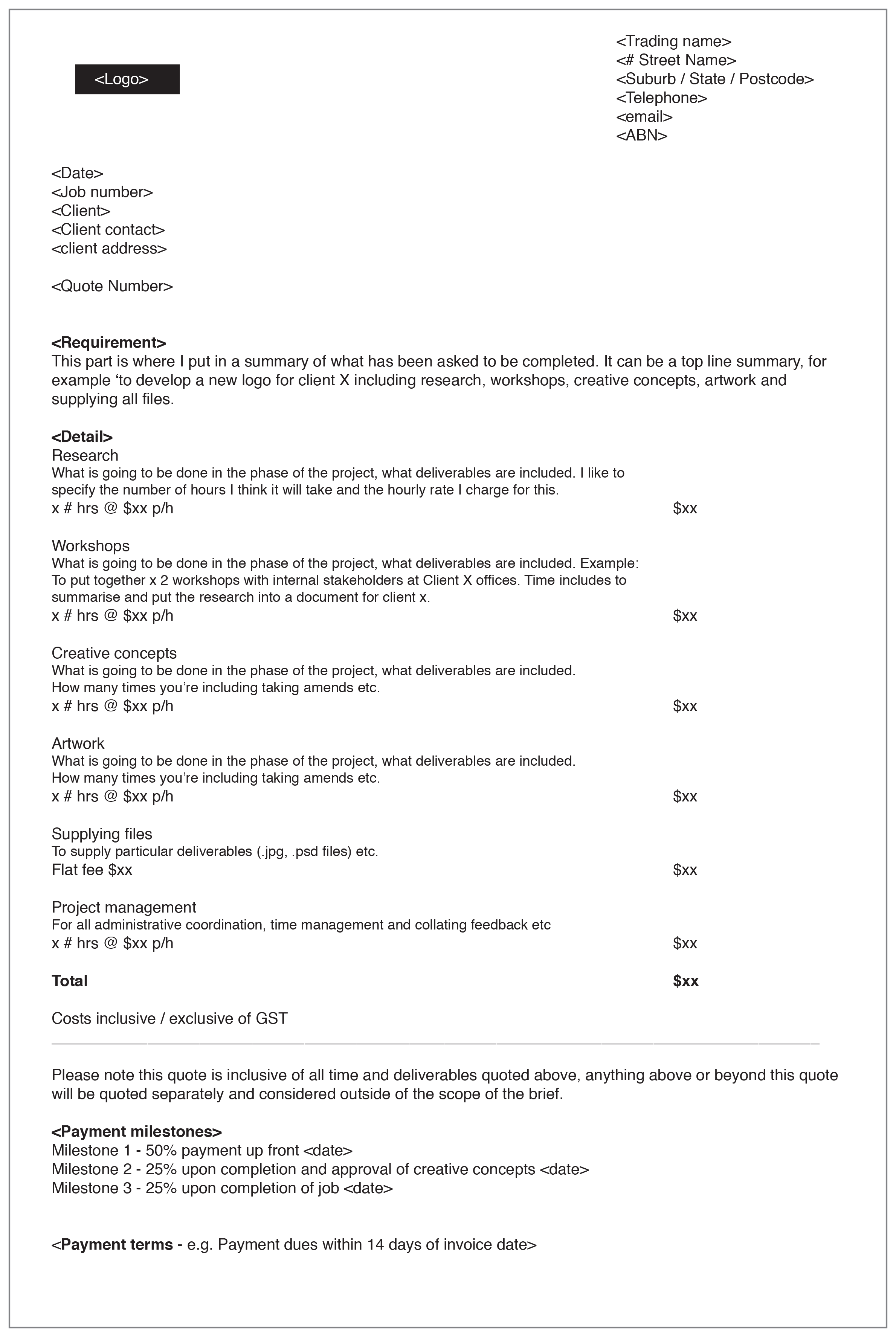
I can’t tell you how many times I’ve seen a client request something extra during the course of a job (adding to your time or the skills and experience you bring to the work), and then refused to pay for it because the details of the initial quote were ambiguous. When it comes to project quotes, the devil is in the detail. Unless your quote clearly outlines what is and isn't included for the total price you're quoting (before any actual work begins), if the final fee is above what the client expects, it can be a difficult conversation to have.
The key is to be very, very detailed in your quote and if a request for additional tasks or the scope of the job changes after the original quote is approved, then it's good practise to provide them with an additional quote or 'change request’ and have this approved also.
With any quote, ensure you get the client to sign it off and/or supply you with a purchase order before you start the work. I know that sometimes this admin side of business can get in the way of doing the real creative work, but it is important - a few minutes to do this correctly can save you so much time and hassle in the long run.
Here’s an example of what kind of information I might include in a quote.
Preparing an invoice
An invoice is what you send to the client in anticipation of a payment milestone or completion of a job. It details the work that has been completed (or details of a deposit before starting a job) and includes your business details, bank account details, payment terms and other essential tax information.
Here’s an example of what an invoice could look like:

While it might be tempting to simplify your invoice down to a single final 'amount due' total, I personally find that an invoice which contains almost as much detail as the original quote can alleviate many client queries and objections (and possibly the delay of payment). You don't have to list a blow-by-blow account of the work completed, but a client will generally appreciate some detail of what is being invoiced for.
The tax stuff
An ABN (Australian Business Number) is important to have, although it isn’t mandatory if you're a sole trader. However, other businesses may be legally bound to withhold almost half of any payment to you for tax if you don’t quote an ABN on your invoice. Half! You maybe able to claim this back at tax time, but in my opinion it is better to apply for an ABN at the Australian Business Register and have this ready to supply to any potential client.
Registering for GST is another thing to think about if you run a creative business in Australia. If you are expecting to earn less than $75,000 per financial year, then technically you don’t have to register, but if you think you could be nearing that amount then you may need to. Have a look at more info on registering for GST here, and be sure to contact a professional in the area of tax and accounting before you send off your first invoice.
---
I know numbers aren’t always the ‘fun’ bit of running a creative business, but they are necessary and it is important to set up good systems from the outset. Of course, professional advice from an accountant, a lawyer, bookkeeper, the ATO or other professional body is always recommended before you jump in head first into quoting or invoicing for your creative work or starting a business - it may save you a whole lot of hassle and pain in the long run. Then you can have some fun with the money that comes in at the end for all of your hard earned work!
Jes is a ‘practical creative’ and a very busy lady, doing the business in a digital agency, being an artist, a university lecturer, and small business owner who can creatively be found cutting up a storm at paperchap.com. Follow Jes on Instagram and Facebook.