
The Creative Business Traveller’s Toolkit
 By Diana Scully
Last year, I shared with you my tips for relocating yourself (and your creative business) overseas, based on my recent experience doing just that from Melbourne to Los Angeles, taking my interior design business with me.
To be honest, setting up a new home and establishing a new work lifestyle has not been as glamorous as I had initially imagined. Let me be clear, spending time in LA and the US generally has been incredible, exciting and a total adventure, but when your business is set up in Australia, a relocation to a new city brought along some new challenges.
But I've worked hard and want to share with you today my 'business traveller’s toolkit': a repertoire of essential services I needed to stay connected to my lifeline back at home AND remain flexible in the US. I hope these tools will offer the support you require to travel with simplicity, enjoyment and greater peace of mind - for short or long periods of time.

Your essential gear.
These items may appear obvious, but if you aren’t accompanied with the right tools to travel, stay organised and be more flexible, it’s going to be a long unproductive day - every day - on the road. Seriously.
1 / A light-weight, reliable laptop. The market has so many good options so its up to you to choose the right one for you. If international travel is on your agenda, consider an Apple product as their warranty covers you worldwide. Last year, when my computer completely shut down one morning (who knows why!), I was able to visit my local Apple store in Santa Monica and receive assistance on the spot. The issue was rectified immediately (including my streaming tears) and didn’t cost me a dime.
2 / Another obvious one, but a reliable mobile phone that allows for international data roaming and sufficient storage for all the apps you’ll need (see below). Make sure you activate international roaming before your departure to avoid having to sort this out when you arrive in your new location.
3 / A hard disk drive to back up everything! I set up reminder on my laptop to back up my work on a weekly basis. It has been a lifesaver, especially when my laptop shut down completely that one day. Also, a hard drive is a good place to store your ever growing travel photo collection (rather using up valuable storage space on your laptop). You’ll need as a minimum 1 TB of storage.
4 / A good pair of headphones with premium noise reduction feature is a must. For the many occasions I found myself working in public places like cafes, co-work spaces and libraries I needed my headphones to block out any distractions. My headphones also came in handy listening to music and podcasts in long lines, on road trips and in airport lounges.
5 / The final piece is the ultimate bag. Depending on your style, make sure its comfortable to wear for long periods of time and large enough to factor in cords, adaptors, drink bottle and lunch! For me, this was a back pack with padding for extra support.

Your essential online services.
Now to the good stuff. Here’s the essential digital services I found most useful while away from home. You may already be using some of these, but hopefully you’ll discover a few good new ones to add to your own toolkit if travel is on your agenda this year.
1 / Skype - No explanation needed here. This was my direct line back home either for telephone or video calls. A great option for my clients who called to show me the progress of their home.
2 / WiFi Finder App - Prior to my departure to the US, I never envisaged having difficultly finding WiFi in the US, particularly LA and NYC. However, proven wrong in the first week, access to free WiFi was not as readily available as I had hoped (plus I didn’t find the interiors or the coffee at Starbucks the must conducive to a good day’s work!). Luckily this app helped me locate both free and paid WiFi services on the go.
3 / Dropbox - A place to save and store all your work using their cloud storage system. Firstly, if you ever need more storage, you can simply buy it online (without having to buy another portable hard disc drive). Also, you can create public links to your files to share with clients and travel photos to share with family. The collaborative nature of this service is a winner.
4 / Xero - This is a brilliant service to manage all your accounting and business finance needs online and via a mobile app. When I incur any business expenses as I traval, I simply take a photo using my phone and upload it immediately into my Xero account. Goodbye paper trail! Also, my accountant is able to log into my online account and manage any issues from her own office. This real time aspect allowed for issues to be dealt with in a timely manner and avoid unnecessary phone calls at unusual times of the day. While its not a free service, the various fee options available are very reasonable and certainly a worthwhile investment.
5 / Desk Time App - There have been some times when I can’t fathom working another day in another cafe all alone. So I loved to search for co-work spaces nearby using the Desk Time app. If your budget allows it, a co-work space is a great opportunity not only to give you access to reliable internet and amenities that you’ll need for a great day’s work, but an opportunity to also interact, network and meet new people. While in Santa Monica, I had the opportunity to work at Google’s old headquarters (which is now called ROC). Whilst here, I met some wonderful people, including future clients and one of the celebrities from the US TV series, The Bachelor! I also heard that Jessica Alba had her own private office here, however, I unfortunately never ran into her.
6 / Hoot Suite App - A popular online service to plan and prepare all your social media platforms in advance. While I’m the type of person who likes to prepare social media posts only a day or two ahead, when my husband and I decided to take a road trip along Route 66 for two weeks, I knew that access to WiFi was going to be limited, especially in the desert!
7 / Trello - If you love lists and tools for keeping organised, then you’ll love Trello. This online service allows you to organise projects into boards and even access those boards via a mobile app (which I found perfect when I wanted to snap a photo of a cool armchair and upload it immediately to a client project board). Trello also allows you to invite team members, clients and family to your boards to add comments and upload images.
8 / EventBrite - Prior to leaving for the US, I jumped onto this site to see what events, seminars and gatherings relating to design were on in LA. Fortunately for me, at the time, one of my favourite design bloggers was holding a seminar at her studio on social media and blogging - So I grabbed a ticket and a month later, I was in her studio in LA talking with her! So exciting! A great platform available in many countries around the world to connect you with events in a new city.

While this list of services is not exhaustive (I am yet to find the ultimate app that locates for you the best coffee in the US), they’ve all been super helpful in keeping me connected, organised and productive with work commitments and my nomadic lifestyle. With just about everything now being available online, it meant I could travel more lightly and freely, which is the ideal way to travel (trust me, I learnt this the hard way).
If you have any other great online services to recommend then please share them with us via Instagram, Facebook or Twitter. I’m back in Melbourne at the moment, but off to the US again this year and this time I'm feeling a little more prepared and ready! I hope that these tools empower you to feel in control and secure with your travel/work adventures too.
---
Spaces by Diana is all about designing beautiful, personalised homes that reflect the owners. Principal Designer, Diana Scully, is passionate about creating homes that offer good design without the price tag. Diana also has her own lifestyle blog, Spaces + Places, where she regularly writes about inspiring spaces, places to visit and recent travel adventures. This year she has plans to spend time abroad in the US. Follow Diana on Facebook, Instagram and Pint
{Images via Death to the Stock Photo}
5 things to consider before opening an online shop
 By Monica Ng
It’s the beginning of a new year and perhaps you’re finally ready to open your own online shop. Congratulations! With an increasing number of consumers shopping online year-on-year, buying everything from fashion, accessories, home wares, electronics and even food, it’s an exciting time to start selling online.
With so many different websites and platforms offering 'quick setup' ecommerce options, it may be confusing deciding how to actually start and which platform you’d like to sell on. Plus, there are a few other things worth considering before you open the virtual doors for business.
Here’s my tips:
1. Do some market research.
- Determine if your product is something that customers regularly purchase online (price, size and materials of your product may be a factor here).
- Determine who your target audience is and figure out their preferred online shopping platforms (see #5 below for some examples!).
2. Think about finance.
- Ask yourself what percentage stock do you want to sell directly through your online shop, versus alternatives such as wholesale or consignment to other bricks & mortar or online retailers?
- Check out postage costs through couriers or Australia Post - some postage fees can be prohibitive to customers buying online.
- Factor in the time you'll spend photographing products, uploading product listings, preparing items to post, and even going to the post box or lining up at the post office for each and every order.
- Think about associated costs like tech support, product photography or graphic design if you don't DIY.
- Look at any fees associated with your chosen platform (see #5 for some guidance here).
3. Think about branding your online shop.
- Do you have existing business branding that will be applied to your online shop?
- Consider how tech and design savvy you are in terms of actually setting up an online shop. Do you have any friends/family who can help you?
4. Marketing and promotion
- What is your marketing strategy to drive customers to buy online?
- Do you have a strong following on social media prior to launching your shop, or are you just starting out? If the latter, how will you build your following?
- What online or offline channels will you use to promote the online shop?
5. Decide where to set up shop!
With so many different websites these days, it may be confusing deciding how to actually start and which platform you’d like to sell on. Here’s a guide to some of the key ones for creative businesses.
Etsy
Etsy is an online marketplace dedicated to selling handmade, vintage items and supplies as well with millions of unique items from shops in over 200 countries.
Pros:
- Easy to set up a shop. If you don’t know much about HTML and CSS, no problem! With a standard shop template there are options to customise your shop and the choice to link to your social media accounts
- Etsy has an extensive sellers handbook full of articles, interviews, online labs and livestream videos dedicated to all aspects of the shop ranging from branding, photography, graphics, marketing, wholesaling and Search Engine Optimisation (SEO) to name a few.
- Large and growing community, where you can join teams and contribute in the forums to ask other members and shop owners for advice, “heart” (favourite) items and shops and curate treasuries. Joining in the community can in turn bring more traffic and even sales for your shop!
- Ability to accept different payments via Paypal and direct checkout includes using credit/debit cards, Etsy gift cards etc.
Cons:
- With so many Etsy sellers, there is a lot of competition and its product categories have become saturated. Furthermore, Etsy broadened its definition of “handmade” in 2013, to include manufactured items, which may make it difficult for your items to stand out amongst the crowd.
- Customisation options are limited, with all shops following the standard shop template, shop owners can only customise shop banners and a profile page.
- Although the fees appear small, they add up. Etsy collects a $0.20 listing fee, which covers a 4-month listing period and then charges a 3.5% transaction fee. In addition, to this if the customer pays with Paypal, you also lose their fee from the total transaction price. If you have a high turnover of inventory and re-list products often, at some point it may be more economically feasible to pay a monthly flat rate on a different platform.
- Customers must have both an Etsy and a PayPal account to make a purchase. Signing up for an account may deter some customers and they may not end up purchasing your wares.
Big Cartel
Founded in 2005, Big Cartel is home to over 500,000 shops allowing makers, crafters, designers and other artists to set up an independent store to sell their products.
Pros:
- Ability to customise your shop – from simply changing the fonts, graphics or colours to modifying the HTML and CSS directly you have complete control over how you wish your shop to look. In addition, you can add slideshows to show off your new look book or sale promotions or even add custom pages such as an artist’s biography or FAQ page.
- When customers land on your site – there are no shops or advertisements to distract or lead them away to another shop, it’s just your shop.
- Offers a fully functioning free and paid plan options. Perfect for new shop owners, from free to paid plans starting at $9.99, $19.99 or $29.99 a month, each subsequent plan allows you to list more products and access additional functions such as inventory management and more data in your visitor statistics.
- Sales history is private. All sales information is only available for your eyes, so snooping competitors can’t get a look in.
Cons:
- Shops have to generate own traffic. Although there is a shop directory, most shops would need to drive traffic to the shop from social media, blog or other channels. As a new shop, this may be difficult as your fan base may be small. Also there is no search bar for customers to find you and your items.
- Not much of a community. Unlike Etsy, where there is extensive support system such as teams, forums, live labs etc it may be difficult to reach out to fellow shop owners for support and advice.
- No Phone or chat support. Big Cartel only offers email support Monday–Friday from 9am–6pm.
Shopify
Shopify launched in 2006 and today is home to over 120,000 shops that use the platform to sell online and to power retail sales in person.
Pros:
- Completely customisable shopfront. There are many store templates to choose from (both free or paid) and you can design your own template using HTML and CSS.
- Good value if you sell a high volume of high value items, as Shopify charges a flat fee per month and a transaction percentage depending on which plan you choose.
- Customer service is clearly at the heart of Shopify. Customer support via phone, live chat or email is available 24/7 as part of its monthly fee.
- Offers a range of payment gateways for checkout. Shopify can directly accept payments or else there’s the choice of checking out over 70 gateways to accept credit card payments.
- App store for third party apps. Adding more functionality to your store can help improve your sales, improve bookkeeping by integrating accounting features and allowing wholesale customers access to different pricing to name a few.
Cons:
- Shopify's fees per month can be expensive. Although they offer a 14-day free trial, the least expensive starter plan starts at $14 with other higher value plans available if more features are needed. In addition to the flat rate per month, there is an additional transaction fee, which may make it expensive especially for new shops starting out who may not sell that much in the beginning.
- Final payment must be taken in the shop’s default currency. Although goods can be browsed in their own currency, customers may get a surprise when the final payment is taken in another currency.
- Reliance on multiple third party apps can get messy. With varying levels of support, quality and costs, managing these may get complicated when you don’t have the option to customise to your liking.
Starting an online shop or have experience with one of these platforms? Tell us on Facebook, Instagram or Twitter.
{Note that this post was not sponsored by any of the businesses mentioned}.
--
Monica Ng left her accounting career at the end of 2013 to run Geometric Skies, her Etsy jewellery business, alongside her jewellery and object design studies at the Design Centre in Sydney. Find Monica on Instagram @geometric_skies or at her blog.
Service design: what it is and how to get it right
 By Jes Egan
Have you ever recommended a restaurant or product and then realised that the product or food wasn’t what you are really recommending, but the experience that you had? Or that time when you walked into the Apple store when there was something wrong with one of your ‘iDevices’ - overwhelmed by the sheer amount of people and massive technology overload - until someone in a blue t-shirt finds you, politely asks what you need and tells you to just have a wander around and ‘Aaron’ will find you. 10 minutes later, and techno guru ‘Aaron’ comes up and says ‘Hi Jane, lets have a look and see what we can do today to fix your problem’. Crisis averted.
I like to call this ‘Service by Design’. Apple have done this very well by addressing the number of people in their store, how intimidating this can be and how hard it can be to get served at times in these situations. They have just thought about everything they possibly could and developed a solution in advance.
Put simply, service design is when a company, no matter how big or small, or in which industry, thinks about every single aspect and touch point that you may have with their company or brand, and both considers and designs how to respond at each individual point.
Look at it from a different angle, have you ever not returned somewhere or purchased again from a company because you had a bad experience? I’m pretty sure we’ve all done that, a bad experience can be the end of a relationship with a customer, however, if some of it was handled differently it could result in a more loyal and happy customer.
Why service design is important In this day and age, I believe a business can no longer be just about the product/service that they sell - it has to be much much more than that. Each purchase has to be packaged with a positive experience in order for that business to stand out from the crowd. This is particularly true for a small businesses, and it really doesn’t matter what you sell, from coffee to jewellery to photography to management solutions.
To stand out from your competitors or create a lasting impression, any interaction a customer has with your business needs to go above and beyond expectation. It is so much more than just exchanging money for purchase.
How to do it The elements of service design in one business will differ from the next, but there are some fundamental basics that can be applied and tailored to the specific needs of your individual customers:
Communication Communication is key. Consumers like to know the status of their purchase at every stage, particularly if it is an online purchase. Keeping your customer informed of the progress of their order is a little thing that can take only seconds to do (or less if you have a wonderful automated system). I personally get really excited when I receive an email or text saying that my order is in the delivery van and on its way. It builds up an anticipation about its arrival and sometimes - even when it is not something that is even that exciting - because I know it is on its way, I can anticipate that I should stay in to sign for it, or put that 'do not ring doorbell!' sign on the door (so the babes don’t get woken up!). Either way, I appreciate the communication that my purchase is on its way.
Alternatively, perhaps there is a delay with my package being sent out. Being aware of this in advance alleviates any worry or negative thoughts that might come about when it doesn’t turn up as expected.
Delivery It is such a simple thing, but the way a purchase is delivered to you can make such a huge difference. Whether you are buying face to face in a shop or at a market or an online delivery - everything from a helpful, happy sales person; a beautifully wrapped item; a handwritten note or a simple thank you. A package doesn’t have to be extravagantly wrapped, just a considered wrapping/packaging experience will do.
Follow up More often than not, this stage is overlooked. Many businesses treat the delivery of a purchase as the final transaction. It doesn’t have to be. If it’s a product, a simple email or follow up call to say 'thank you' or to offer a discount on a future purchase might be all you need to do. If you’re wanting to offer a more personalised service, a quick call or note to see if your customer was happy with their order can really make them feel appreciated.
If what you’re offering is a service, the same rule applies. Tailoring this to your business and clientele is very important - you should only do this kind of thing if you can make it relevant to your audience. A simple follow up may be all it takes to gain a loyal client. After all, studies show that it is cheaper to keep an existing customer who purchases repeatedly from you than it is to acquire a new one.
Disputes The truth is, they do happen. How a dispute is handled by your business can be the difference between a very unhappy customer (which can translate to vocalising that unhappiness on social media) and a customer who walks away reasonably satisfied. While customers can be difficult or unreasonable at times, it is important for a business to act professionally and resolve problems efficiently and kindly.
While I’m not saying you have to 'give in' and go against what you think is fair or right in the face of a demanding situation, but ensuring you deal with the issue quickly and politely can resolve it much faster and more effectively. Perhaps it is something that is out of your control, such as a third-party postal or delivery issue. The best time to think about how to respond to a dispute is not when you are in the middle of it. If your heart is entrenched in what you do, it can be really hard to not take it personally when a dispute arises. So thinking about what you would do in advance can be very effective. A solution such as offering a discount on the next purchase or a small token of appreciation could help ease the tension, and is easy to set up in advance should you ever need to play that card.
Over to you Service Design can create value. Creating a positive experience for your customer by designing your service around your offering is so important, and often overlooked. In most cases, once you have thought through how you are going to interact with your customer and put your plan into place, it’s a simple process and hopefully will become second nature. Adding a bit of service design to your business can help you create a warm and appreciated experience around your business. And service design is all about designing that experience.
Jes is a ‘practical creative’ with a past life in advertising. These days Jes is an artist, lecturer, and small business owner who can be found cutting up a storm at paperchap.com. Follow Jes on Instagram and Facebook.
How to run a business with your partner
 By Emma Clark
For some couples, working together makes perfect sense. You have complementary skillsets, share a passion and vision and you obviously like them as a person and enjoy their company. Why not build on that and start a creative business together?
If you can make it work, setting up shop with your favourite person allows the kind of freedom, flexibility and work-life balance that creative people dream about. My husband and I run a bespoke timber furniture and joinery company, which allows us the flexibility to raise our young sons together. However, it hasn’t always been smooth sailing and there has been plenty of roaring arguments negotiations to get to where we are now. Here’s our advice to keep your business and relationship on track and out of the divorce court.
Be 110% sure it’s right for you Going into business with your partner is both a personal and professional investment, so think hard about your relationship and goals before working together. Relationships and careers can be difficult enough without combining the two, and a strong marriage doesn’t necessarily translate into a successful working relationship. Remember that in thirty years the business might not be there but the relationship will.
The financial risks can be significant, too. Having both partners working in the same business can be a case of putting all your eggs in one basket, so be sure to do your due diligence and be aware of the financial ramifications in case the business doesn’t work out.
That said, working together can be a great joy: it can strengthen your relationship, provide more flexibility and improve work-life balance for both of you, especially if you have kids. After all, you get to spend time with your favourite person and create something spectacular together!
Have clear roles It is unlikely that you both have exactly the same skills, so identify your strengths and weaknesses and work accordingly. For example, my husband is an amazing woodworker but struggles with dealing with clients, whereas I love chatting to people but don’t have the same trade skills, so I do the bulk of the client communication and he builds the actual furniture. We both enjoy the collaborative process of designing, so we work together when sketching new designs and bouncing ideas off one another.
A big part of having clear roles is to trust the other person. This is much easier said than done! Don’t try to do their job. Sure, you can offer advice and help each other out, but try to step back and let them have the final say. Constantly ‘checking in’ on the other person is exhausting and undermines their ability to get the job done. The answer is to know your role and stick to it.
Communication is key Keep talking! This is important in all relationships, not just for business or creative partners. Constant communication with each other is imperative in order to stay organised, happy and sane. Be your partner’s biggest fan and celebrate even the smallest wins together. If my husband and I aren’t in the workshop together, we are constantly sending pictures to each other of what we are working on or what he has been building. It’s an easy way to stay in the loop and to keep the creative process moving.
Regular date nights, even if it’s just takeaway in the backyard after the kids are in bed or a quick drink on the way home from work, can go a long way to reaffirming your relationship as a couple. Even if you have spent the working day together, asking, “How was your day?” or “How are you feeling today?” will go a long way in ensuring the other person feels supported and heard.
No shoptalk as pillowtalk – and vice versa This is a hard one. When you work with someone all day, or even just part time, it can be hard to switch off at the end of the day. It’s easy to mention a frustrating client email while you are eating dinner or remember a forgotten invoice as you are both brushing your teeth. While this is inevitable up to a point, try your hardest to keep work at work and mentally switch off at home. Above all, you are romantic partners, not just colleagues.
The opposite is true as well. It is easy for squabbles and bickering to carry over from home to work, which, coupled with the daily frustrations of running a business, can lead to resentment and seriously affect your work and relationship. Try to leave your bickering at home, especially if you have staff or other people around. Nothing is more unprofessional and awkward than being trapped between bickering spouses at work.
Share the same vision Don’t assume your partner shares the same business goals. If one partner is aiming to have your products stocked on department store shelves and the other wants to focus on craft markets, your business will struggle. It is a good idea to map out a clear plan of what you imagine your business and lifestyle will be like. Having the same goals and vision for the business is the best way to ensure it continues to grow and evolve.
Having a shared vision for your work/life balance is helpful too. Sorting out all the practical issues such as working hours, childcare, getting to and from work and wages will help you to align your expectations and help ensure you are both feeling in control.
Emma Clark is an interior designer, writer and podcaster who, alongside her husband Lee, runs Gratton Design, a timber furniture and architectural joinery company. She blogs at Worst House Best Street and posts endless photos of her sons on Instagram at @emmamakesthings.
{Photo by Ben Vella at Shoot Everything}
My Advice: Tips for the New Year
By Lizzie Stafford

Two weeks in to the start of January this year I signed a lease on a new shop. The year before was a bit of a ‘nothing’ year, and when I got to the start of January it was one of those moments when you think ‘Right, what is actually going on here.’ I sat at the kitchen table with coloured pens and a sheet of poster board and decided it was time to get real. I wrote down my ‘resolutions’. They had to be possible, but still challenging, and about doing ‘good’ rather than ‘lose 5 kgs’ or ‘get better hair’. Then I just wrote things I really, really wanted to do in large capital letters, like OPEN A SHOP, and I kept the poster visible so it was staring me in the face whenever I went near my desk. For the first time ever, I actually managed to come through with my resolutions. (Okay, most of them, anyway. Nobody’s perfect).
Normally I wait until the end of January to start to do anything, because everyone is on holidays, or it’s too hot, or I have the rest of the year to do it. And then before I know it it’s December and I’m adding it to next year’s resolutions. But I found getting motivated from the very start, and ticking off as much as I could in the first month, gave me the momentum I needed to keep me going for the rest of the year.
Of course, everyone’s different, and there is nothing wrong with taking time out in January to reflect and recharge. That’s the advice of one of the creative women when I asked about what she does to get motivated in the new year, and a trip to Europe sounds pretty darn inspiring to me.
Nick off overseas!
Elizabeth Bull, photographer and owner of One Fine Print
My first knee-jerk-reaction response when asked about tips for the new year, about getting motivated and making the most of new beginnings was: nick off overseas! As that's what I am doing on the 1st of January next year. It's a completely self-indulgent trip I've decided to take right in what historically has been quite a busy time for me! It was also what I did last January. So I thought, really am I the best to comment on this?
But then I thought about it and considered how time away from the business is actually what I've always done to prepare myself for the new year. Very early on in my business I did something that has now become my end of year activity that sets me up for the year ahead and something I look forward to and feel keeps me grounded for the busy year ahead. I go down to the beach for a few days, I sit around in a deck chair and do nothing much. It feels like a great relief after a busy December and year gone by. It really gives me the ability to just sit and think, and to discuss and play with ideas that have been swimming around in my head.
Now don't get me wrong; I travel and take breaks all the time. But rarely do I do the relaxing, sit around holiday. But when I do the “sitting around and relaxing” thing in December, I come back in January refreshed and ready to go. Over that period I think about my goals and what I've achieved in the previous year. I re-evaluate and think about what I really want out of the next year. Not in a New Year’s resolution type of way; more like a to-do list of what I'd like to achieve and how I could go about doing it.
A couple of things I've found help me clarify my thoughts during this time:
1) We completely shut down. It's the only time we do. No email correspondence; just a nice “see you in the New Year” auto responder. This time away from the computer helps me think and have real clarity without any distractions. (I don't even like cats, why am I looking at this cat video!). I guess it works for me the same way as why the best ideas always come to you in the shower.
2) Don't put pressure on yourself to "figure stuff out". Sit back and relax, and the good stuff will come to you. Surrounding yourself with people who you feel inspire and challenge you helps as well because you can bounce those thoughts around and talk them out.
3) Put your thoughts and goals into a to-do list that is achievable and manageable. Break down your ideas into small tasks so that when you are back at your desk in January you don’t become overwhelmed and disheartened.
Set the intent but leave the specifics of it open-ended.
Karina Sharpe, conceptual artist and product photographer
At this time last year I was in the process of a big decision. I had been working at my jewellery design business Karina Jean, part-time amongst motherhood, for a number of years and had just had my biggest success with a design called The Pencil Necklace. Yet in the midst of filling all the beautiful Christmas orders, I was feeling a calling to switch paths. It wasn’t an entirely new calling or an entirely new path as I had been making imagery of one kind or another, alongside the jewellery, for some time and had spent much of the previous 12 months feeling torn between the two endeavours. I knew at my core that I couldn’t actually do both with any noteworthy success. I realise now that sometimes it takes success in something to really test your love of it, and I found my love lay elsewhere. So in January this year I began to make changes from a product-based selling business to an image-based service business / artistic practise. And much of the rest of this year has been about putting things into place and finding my niche.
For me, 2015 feels like a time for cultivation and creative exploration. In January I will make some plans for the New Year. I don’t really do New Year's resolutions in the traditional sense. I don’t go “I’m going to get fit and join the gym”, “I’m going exhibit my art” or “I’m going to make more money”. I choose to phrase things in a way that is based more on the concept or the feeling of the things I want more of in my life, rather than them being fixed goals. So instead I will say things like “I’m going to feel happier in my body”, “I’m going to make beautiful progress with my art” and “I’m going to feel richer in all areas of my life”.
I like to set the intent but leave the specifics of it open-ended. That is because I believe if it is up to me personally to set the specifics of the outcomes, I can really only set them based on how big I can imagine them to be and that can really only be based on a reasonable extrapolation of what I have already experienced. If I leave things open-ended for the Universe to deliver in its own way then the outcome can be beyond what I could have imagined for myself and things seem show up in amazing, random, and wonderful ways.
Use charts and lists and schedules, broken down into three simple questions.
Amalie Wright, director Landscapology
Charts and lists and schedules come pretty easy to me, but to know what needs to go on all those charts and lists and schedules for 2015 I’ll be taking time to answer three deceptively simple questions:
1) What is the big aim for this year? This sets the broad parameters for all other decision-making on a yearly, monthly and daily basis.
2) Who were the most inspiring, engaging, talented and fun people I worked with last year, and how do I get to do more work with them, or people like them, this year?
3) What are the things I need to do less of this year, in order to achieve numbers 1 and 2?
Lizzie Stafford is a lifestyle and entertainment writer and owns and runs Künstler, a magazine and bookstore in Winn Lane, Brisbane.
7 Tips for Starting a Podcast
 By Tess McCabe
Now that you've had a week since my article 'How to download and listen to podcasts' to download shows, binge-listen and basically become obsessed with podcasting, perhaps you're thinking: I could do this!
By Tess McCabe
Now that you've had a week since my article 'How to download and listen to podcasts' to download shows, binge-listen and basically become obsessed with podcasting, perhaps you're thinking: I could do this!
That’s great! Today I'll offer some tips on how to start your own podcast.
But first, another tech disclaimer: Emma and I are relatively new at this too, so we don't have it all down pat yet. But the info contained herein is a pretty good foundation for getting your first ep online
1. Decide on a topic. As discussed last week, most podcasts have a niche theme or overarching format, and that's what draws in listeners. When deciding what to make a podcast about, I first looked to my interests. One of my main interests involves asking people about their creative businesses (which, lets face it, I do a lot of already in various other forms!). I like TV and film, but I can't really talk about those topics in a 'critical analysis' kind of way without sounding like a dum-dum. I do like talking about my kid though, and asking people about their family situations, and talking to my mum friends. Ding! Hours of interesting content ideas suddenly presented themselves.
Having some kind of structure to your talk-topic also helps. Emma and I have somewhat of a content calendar in terms of planned interviews (which helps when one or the other needs some time off, to, like have a baby or other such important life event). We also have a running list of interesting conversation topics and topical questions to ask, and apply these to guests as we see fit.
2. Decide who you will talk to. Most of the podcasts I listen to feature between 1 and 4 people talking. Grace Bonney, for example, sometimes does an episode of After The Jump on her own about her business experiences, and sometimes she has a guest or two to interview. WTF with Marc Maron and Conversations with Richard Fidler are usually a one-on-one interviews with a different person every episode. Chat 10 Looks 3 (the brilliant new podcast by journalists Annabel Crabb and Leigh Sales) is just the two of them chatting. On The New Normal, it's generally always Emma and I interviewing a guest.
Having different guests on your podcast comes with its pros and cons. Pro, you (and your listeners) get to meet and hear different perspectives from different people. Con, it can be a logistical effort to organise guests and find new people to feature every episode.
The pros of working with a partner on a podcast are obvious: halve the workload, double the fun! Given that I have a podcasting partner, I can't think of any cons right now... probably just the logistical effort of coordinating schedules.
3. Practise talking. This one sounds like a joke, but it's not. I did NOT realise the weird and annoying (to me at least) things that I do when I talk until I heard myself recorded! Eek! With the help of editing software (see below) one can edit out unnecessary 'ums', voice cracks, and pauses post-recording, but it helps to train yourself instead to be conscious of how you talk. If this involves practise, then do it. If it involves writing down notes re: witty anecdotes or questions for your guest, then do it. No-one likes to hear drawn out 'soo... um, there was something else I wanted to ask... ummm'.
It's also worth considering the format. Practise holding back if you're inclined to talk over people. Practise speaking up if you tend to mumble. And most importantly, if you're interviewing a guest, practise listening - it's likely your listeners will want to hear what they have to say slightly more than you!
4. Figure out how and where you're going to record your podcast. We record TNN on an iPhone through an app called iTalk. It's free, and the quality of the recording is decent even without needing a separate microphone.
Considerations such as how quiet your location will be is important. Again, test your equipment in your location to see what works (I never realised how squeaky my dining table chairs were until I thought about sitting down to record there!)
5. Edit and add music. Who doesn't love a catch jingle at the beginning of a radio show? Our theme tune was custom written just for us (helps to have friends with songwriting/producing skills!), but for the CWC podcasts and recordings I found some royalty-free music online for which I pay an reasonable annual license fee to use.
Remember, you can't just use any old song as your theme song, as these would more than likely be protected by copyright.
In terms of editing a recorded file, we use Audacity. It takes a little getting used to using but once you're accustomed, you'll be cutting and editing like a pro. In an editing program you can add your theme music to the start and end of your episode, tighten the episode by removing ums, ah's, coughing fits and even boring conversational tangents, and export the file ready for uploading online.
6. Get it out there. There are a few ways to get your complete audio file online and into the ears of your loyal listeners, but often it can be a bit of a convoluted process of workarounds if you want it to remain free and (relatively) easy. Our episodes are uploaded to our BandCamp page, embedded from there via HTML code into our website blog, and then that RSS feed talks to iTunes so the episode pops up there.
iTunes is where you really want your podcast to be, but there are a few rules - you have to be 5 episodes deep before you can apply, and they have to approve your show before they put it on their system.
7. Promote and build an audience. Just like any blog or creative business, promoting your podcast and building an audience takes time, determination, and some marketing know-how. Becoming more readily 'findable' on iTunes involves gathering listener reviews, and encouraging listeners to subscribe, so that you pop up in search results near the top. TNN has its own social media accounts and listeners can sign up to receive an email whenever a new episode is released. We’re still building our audience, so you can follow us over here, here and here!
Let us know if you start your own podcast this summer!
How to download and listen to podcasts
 By Tess McCabe
As someone who has worked solo for much of my career, listening to podcasts as I go about my day have become a big part of my life. There are a few podcasts that I listen to regularly, and often times when I have found myself alone for 8 or more hours a day, their hosts have become like virtual studio mates. (There was a running joke when I was pregnant with my son that once born he would recognise Ira Glass' voice more readily than my husband's!)
My definition of a podcast is essentially an online radio program. Sometimes, actual broadcast radio programs will archive episodes online for listeners to access at any time. Other times, a podcast is only available online and not broadcast via any other media. These are usually pretty niche in their topic, and unless it's the focus of the show they rarely take breaks to play music. The podcast hosts are often just regular folk with something interesting to share (i.e. without any professional broadcast experience!).
Earlier this year, with my friend and fellow creative mum Emma Clark, I started a podcast: The New Normal. On each episode, we interview a guest about their experiences as parents, and try to glean how they make family life work while also maintaining a career or a business (and some semblance of a social life).
Probably the number one question Emma and I have been asked since starting our podcast is: How do I listen to it? Or indeed, any podcast?
So this post is a quick answer to that question. Disclaimer: I'm not the most up to date person when it comes to internet and mobile technology. I know slightly more than the basics, but don't expect this blog post to explain every available option to you with up-to-the-minute advances in podcast-listening-options. I know what I know, and hopefully it's enough to get you started!
I personally listen to podcasts in two ways. On my computer when I'm working there, or via my iPhone when I'm away from my desk.
Mobile phone listening
I have an iPhone 4, and the easiest way I find to listen to podcasts is through the Podcasts app. This app is free to download from the App Store, and after searching for the name of the podcast or finding one that looks interesting through the categories, I simply hit 'subscribe'. Every time a new episode of that podcast is released, the badge will tell you, and you can find and listen to past episodes as well. (Android users - check out this article for tips on getting podcasts onto your phone.) From there, hit play and away you go.
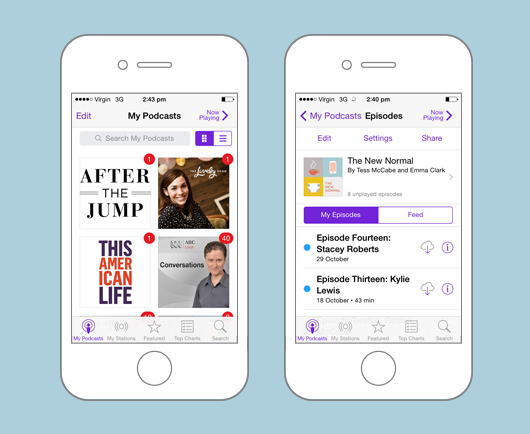
From the Podcasts app you can also download episodes directly to your phone, which is handy if you'll be (gasp!) without an internet signal for a while.
A word of warning though: most podcasts accessed via the Podcast app method use your 3G or 4G internet data allowance to stream the episode live (or to download the full episode). Thus constant podcast listening can chew through your data pretty quickly!
To avoid this, I'll often download episodes at home while my phone is connected to wifi, or download them via my computer as mp3 files and transfer them to my phone like I would with music. Which leads me to...
Desktop listening
I truly despise iTunes. I find it to be so user-unfriendly, but maybe that's just me (see non-tech-head disclaimer above). So generally when I'm listening to podcasts online from my computer, I do so by going directly to the podcaster's website. Plus, I figure this helps the podcaster to know how much website traffic/listeners they have and where they are coming from - something iTunes lacks!
Most podcaster's websites allow you to stream an episode live via an inbuilt 'player' on their web page. Here's an example of our website and the inbuilt player where you can listen directly. Remember though, if your internet connection drops out, or you accidentally close that browser window - there goes the episode!
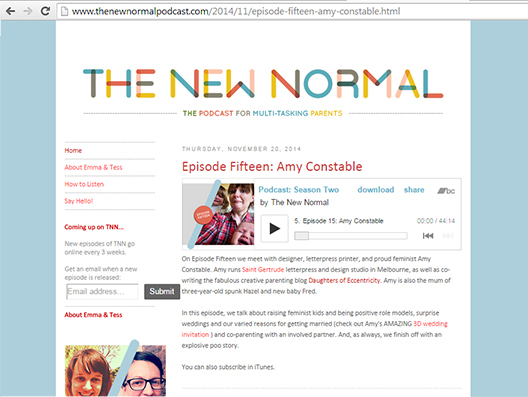
Luckily, most of these players also have an option to download the podcast episode in full as an .mp3. If you download the episode in this way direct to your computer, that file can be played at any time (e.g. through your iTunes music library or other mp3 player). Our own CWC podcasts use this method so Members can listen to interviews and past event recordings.
Finding podcasts to listen to
What I like about podcasts is that I can really hone in on what interests me as a listener. When I'm feeling in the mood for creative business tips and interviews with my favourite bloggers and small business owners, I listen to Grace Bonney from Design*Sponge's show After the Jump, or Jess Lively's The Lively Show. I also like interviews with interesting people from all walks about their lives, and both Conversations with Richard Fidler and WTF with Marc Maron pump these out regularly. Radio journalism on quirky and interesting topics is also a favourite - for these I head over to RadioLab, This American Life, or their new spin-off, Serial. And who doesn't love discussing (in a passive listener way) the challenges of parenting, marriage and relationships? For these topics I like Totally Married, Death Sex and Money, and The Longest Shortest Time.
In terms of finding new shows to listen too, there are a few radio stations that put most of their shows online in podcast form, like our own ABC and WNYC in the US. On Stitcher you can search by category. Most of the podcasts I've found and love I have discovered via blog posts listing people's favourite finds - I bookmarked these posts by Kyla Roma and Cup of Jo (read the comments!) and revisit them when I'm on the hunt for something new.
In a nutshell, that's how I access podcasts and listen to them regularly. What's your method? And what are your favourite shows? Tell us via Facebook, Instagram or Twitter!
Next week I'll explain how we produce The New Normal if you're thinking of starting your own podcast!