
My Advice: How to deal with competition
By Lizzie Stafford
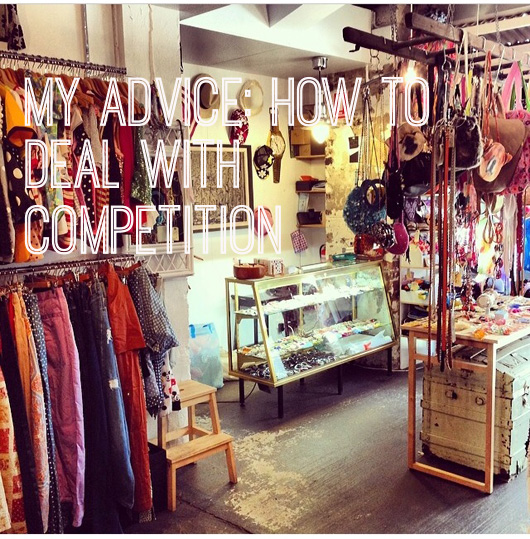
I’ve always experienced some form of jealousy when it comes to my career and that of those around me; I think you have to be pretty confident not to. It’s almost impossible not to compare your achievements (or perceived lack thereof) with those of your peers when social media was basically invented for bragging. For artists, it can be seeing people doing ‘better’ than you, or work that is very similar. For writers, it’s seeing people getting their byline everywhere; and don’t they ever sleep?
Recently I experienced a terrible bout of anxiety when a business very similar to mine opened on the next block. For months before they opened I worried that I would never survive. I oscillated between wanting to be their friend and wanting very much to egg their shop (not even kidding… I didn’t, and the feeling was only fleeting. I’m just being brutally honest here). So it was with open ears and much anticipation that I awaited the response of these three women whose businesses I greatly admire, and whom I was sure had experienced something similar but handled it much better than myself. I was right.
And in case you are waiting for the end of my story; my shop is still going, I am indeed friends with the other business and, as it turned out, we are different and great in our own way. Competition is a very good thing if you know how to use it right.

Stay true to your values and don’t get too caught up in what other people are doing
Daniele Constance, Suitcase Rummage founder and arts practitioner.
When I was asked to write about dealing with competition, I think I felt my blood boil a little! In my work and practice I have had many ideas borrowed, collaborated with, copied, stolen and all of these experiences have had a different impact and brought with it varying emotions.
In general, I think a bit of a competition is good; it's healthy. It keeps you motivated to push your ideas, push your practice further and I think it's really important not to get complacent - particularly if you're starting to do well and seeing some success. Learn from other great ideas, great thinkers, get inspired, and put all of that into your own work.
While I am a big advocate for collaboration and finding ways to work with and support others, it is important to stay true to your values and not get too caught up in what other people are doing. Facebook and social media can be so valuable, but I've also found it to be crippling. I've spent hours trawling through photos, posters for events, blog posts, reviews .... but it's only as useful as you make it. Don't get caught up worrying up about what other people are doing, if their work is better, more successful (whatever the list is). My Dad always used to say to me, "Don't worry about what other people are doing. Focus on yourself." And he makes a good point. You can't control what other people are doing and how successful their businesses will be, but you can control yours.
More recently I have had the experience of others repeatedly using IP and branding that doesn't belong to them, and I think that is really wrong on so many levels. I'm not sure what it's like for other people, but for me it feels like the biggest betrayal. I'm not sure that I deal with it in the best way, but as artists and creative people we're always going to have that happen to some degree. And to some degree, we've all done it, whether we're aware of it or not. It's an excuse on some level for those out there who clearly can't think for themselves (and god I hate it when someone says, 'imitation is the best form of flattery'), but it's also realistic too.
I think my way of coping with it is to write the angry email I want to send, but keep it in my drafts. I come back to it a few hours later and edit it - or write a fresh one that leaves the emotion out. I've also found it useful to seek advice from lawyers and other creative business owners in how they deal with IP and copyright issues (almost everyone has their own story about it).
At the end of it all, it's about finding a balance, a place where you can use the competitive nature of business to move you forward, not backward. That's how I try to think about it, anyway; even when the emotions and stakes are high!
Come up with fresh ideas and stick to your own game.
Jess Barty, owner, Sunday Social
If I’m being honest, I can say that I used to struggle a lot with competition. But one day the penny dropped and I realised that worrying about it wasn’t doing me, or my business, any good.
Nowdays I don’t compare my business to others. Sunday Social has always been about being unique and fashion forward, so I just try to keep coming up with fresh new ideas and stick to my own game. I guess it keeps me on my toes and ensures I do my best!
You better check yourself before you wreck yourself – Ice Cube.
Jenica Smith, founder of Notely and Design Montage, and graphic designer
I recently finished reading #GirlBoss by Nasty Gal founder Sophia Amoruso. She has an excellent quote that really stuck with me with regard to competition. “Compete with yourself, not with others. Judge yourself on what is your personal best and you’ll accomplish more than you could ever have imagined.”
It can be really overwhelming flicking through Instagram and seeing all the gorgeous photos in your feed. I started noticing myself getting down about how nice everyone’s photos look. This led me to get into a habit of only going on there when I have something planned to post. Even though that sounds hard, if I have a day or two, or even just the day to consider my post, then when I do jump on there to post, I feel really excited about participating as I’ve done mine for the day.
The same trap can happen with reading blogs. You could read blogs all night long and then not actually write or plan any articles for your own blog. Perhaps if you are feeling affected by the rabbit warren of social media, then have a couple of days or a Monday to Friday week away from it to get back to your own thoughts.
Another quote I like to remind myself with is Ice Cube’s “You better check yo' self before you wreck yo' self.” Even writing this it makes me laugh! If I notice that I’m being more fleety and trying to check my Instagram or Facebook too often, I like to move those apps to the last app panel in my phone so it’s too hard to keep flicking to them to be able to check them on impulse and to see what everyone else is doing.
Lizzie Stafford is a lifestyle and entertainment writer and owns and runs Künstler, a magazine and bookstore in Winn Lane, Brisbane.
Meeting deadlines with kids underfoot
 By Jasmine Mansbridge
Picasso once said that; “our goals can only be reached through the vehicle of a plan, in which we must fervently believe, and upon which we must vigorously act. There is no other route to success”. I don’t imagine Picasso frantically making kids lunches, rushing to get out the door by eight in the morning, so he could then get back to his studio to paint in a three hour time frame, but I do like this quote as there were never truer words spoken. Basically if you add raising children to any plan that’s when the challenges truly begin.
Deadline stress is unavoidable and it seems that kids have inbuilt sensors which make them difficult when you least want them to be. So considering how to best manage your family as well as your creative work commitments will help you achieve maximum output with minimal stress.
I am a painter and a mother of four children, aged 3 to 17 years of age (with a baby due any day). So I have a broad range of needs to work around. I try and avoid overloading myself with commitments, but when an important date looms (for me that is usually an exhibition), there are things I do to make life easier for myself and my family.
I don’t recommend making a life out of living this way though. Seasons of work, and then rest, benefit everybody in a family. The wheels would come off my wagon if I did the things I am about to suggest all of the time. But, here goes: some things that work for me when facing deadlines with my business.

Simplify your wardrobe.
Get a “uniform”. Mine for a while now has been black converse shoes, jeans and simple T shirts. I just add a jacket or scarf if its cold. This means dressing requires little thought in the mornings and I can get ready in about ten minutes. I save dressing the way I want for weekends and when I am going somewhere “nice”! This also goes for hair, whats happening up there? If it takes you a half hour to dry and straighten it, maybe try a messy bun when you're flat out. You don't have to look unkempt, but streamlining your weekday wear will ease you into a busy day and give you time for other stuff.
Plan simple food.
I generally think about food for the week on a Sunday afternoon. Although I am not a menu planning/spreadsheet kind of girl, a little thought and a quick shop will make a big difference to your meal time stress levels for the week. When I mean simple food, I mean things such as one pot dinners like roasts and pastas. Children can get involved in making food which is also a great help. Lazy meals like soups with bread or slow cooked meals means you can put them on and forget about them until its time to eat.

Fill the fridge with fresh, easy to use ingredients.
When it comes to kids snacks, I cut back on baking and other foods that are time consuming to make. Instead I buy tubs of natural yoghurt and hommus, then for easy morning and afternoon teas I just have to add fruit or muesli to the yoghurt, or savoury biscuits, carrots and celery to the hommus. This keeps everyone full and healthy, without lots of preparation. It will stop you having to resort to the convenience of take away and it also saves money.
Negotiate with your partner/husband to share or take over bedtime and other household duties.
For example, when I am busy painting I can get so much more done if I can at least share the kids bedtime routine. If I can start working straight after dinner at night, I find that I have a lot more energy to paint and I am a lot more productive. If I wait until the kids are down for the night, I find it so much harder to restart my energy flow. Also, negotiate for weekend working time. My husband is really good at helping me get over the line when I am busy, but it does take good communication and verbalising your needs for this to happen. It is also about give and take, so be prepared for some compromise. When my husband is busy with his own work, I do of course try and pick up the slack and do the same for him.
Have an “in bed” and “out of bed” time for yourself!
When I am painting late into the night, I usually get a second wind at about eleven o'clock, even though I might have been exhausted at nine. So, I make myself go to bed by 12:30pm. The times I have broken this rule and stayed up half the night, I have paid for it by being very weary the next day and then I am not able to work the following night. I really have to be out of bed by seven to get everyone ready for school and to be prepared for the day ahead, so sleeping in is an impossibility. I seem to be able to function pretty well on seven or so hours sleep, so my set hours work for me, (though its still a commitment to work long hours). Work out what works for you and try to stick to it. To keep a bit of balance, I usually give myself a night off on a weekend, to watch a movie or do something with my husband.
Get a cleaner in on a regular basis, at least once a fortnight if you can.
If you have a busy life, this is probably my number one de-stressing tip! Having a cleaner won’t mean you don’t have to do housework, but it does ease the pressure on your household while you go AWOL into your creative workaholic zone. If you are worried about the cost of a cleaner, try tallying what you might spend on coffee, wine, or other extras, and all of a sudden a cleaner may seem cheap, (but be warned they are equally addictive).
Source some kind of childcare.
Childcare is a tough one I know, and it can be expensive, especially if your not making any money up front from your creative work. I have had different help at different times. My mother in law is wonderful and has had my youngest children many times when I have a deadline to meet. But mostly I have had to just work with my kids around (not ideal, but necessary at times). I have also paid my teenage children’s friends and other friends to play with and entertain my small children, (picnics or games in the back yard work for a couple of hours). I have used occasional childcare, in the form of two hour sessions available at my local gym. It does take focus to switch in and out of creative mode so quickly and work when you have limited time or you are sharing your head space, but it is better than no time to work at all.
Try and find creative ways to let your children work alongside of you, some of the time.
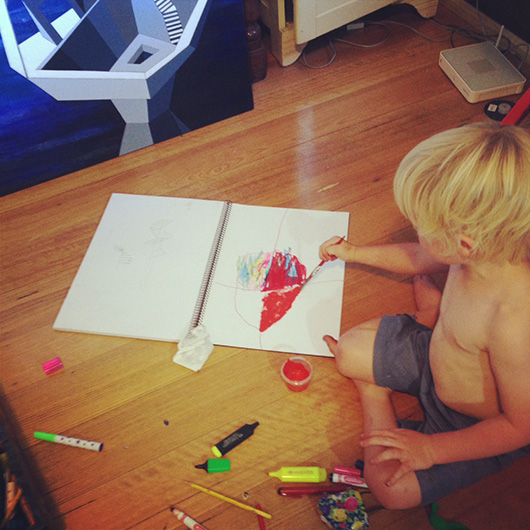
In my studio I have a couple of tubs of basic crafting materials. Pencils, colouring books, glue etc… My children don’t find me painting that exciting, as they are used to seeing me do it on a daily basis. This means they are happy to take up a corner (or half the studio) with their activities while I paint. Age is obviously a consideration, but stick some tunes on and you might get an hour or so of work done and they will get to use their own imaginations. It does take patience and tolerance and a certain kind of head space to make this work for you. If you have a deadline though, a couple of hours will be invaluable. If you are stuck for ideas, the internet is full of age appropriate kids activities, so get Googling!
Don’t take it all to seriously.
This is my last tip, and its because it’s probably the most important. While on the one hand it takes a hell of an effort and consistent commitment to pursue creative success and also raise a happy family, on the other hand , your family will always be your greatest measure of success. So, if you're having a day when you feel like you are banging your head against a wall and getting nowhere, or if you feel tired, frustrated and worn out, then the best thing you can probably do it take a deep breath, call a friend and head to the park or the beach, or somewhere that is not at home or your studio for a few hours! When I do do this I come home recharged and refreshed, my tank full again. Remember being a creative person should be fun! (at least most of the time).
Jasmine Mansbridge is a painter and mum to four (almost five) kids. She regularly blogs about the intersection of creative work and family life at www.jasminemansbridge.com, and you can also find her on Instagram @jasminemansbridge.
{All photos by Jasmine Mansbridge}
8 Tips for Market Stall Success
 By Monica Ng
You open your inbox and you see a new email from the market you’ve recently applied to.
“Congratulations! Your application was successful!”
You ogle at this sentence and you begin to buzz with excitement. You do a happy dance, Elaine Benes style to celebrate your success and show off your rad moves to the four walls of the room you’re sitting in. Yaaay!
My jewellery shop, Geometric Skies has participated in a variety of showcases and markets including some specialty designer markets such as the Sydney Finders Keepers, the Etsy Interactive Exhibition at the Fracture Gallery in Federation Square as part of the L’Oreal Melbourne Fashion Festival, RAW Artists’ first Sydney showcase, The Makery and the fashion markets at Bondi Beach and Kirribilli.
I started from scratch as a complete newbie and through these experiences over the past year, I’ve gained some insight and learned some tricks that may help set up your market day for success. Regardless of whether it’s your first time, or if you’re a seasoned stallholder, here are a few pointers to help you prepare for your next event.
Think about your display Dedicate some time to how you want to set out your work. This is especially important if there’ll be a lot of other stallholders selling similar types of items, like jewellery. I’ve seen a lot of jewellery designers at markets lay their pieces flat on tables, which may make it more difficult for customers walking by to see the work from afar.
Ask yourself:
How can your display be different to other stallholders? Can you arrange it at different levels? Use busts? Racks? Trees? Will you be buying these props or will you construct them? What materials will they be made from? What do these materials say about your brand?
Try to be consistent and use the same materials to display your goods, as this gives your shop a cleaner and more cohesive look.
Also, consider using a mannequin. I use a half body mannequin, so customers can see from afar how some of my more adventurous pieces like ‘The Lily body chain’ looks and fits. Often, this draws in customers who wander up to my shop to have a closer look and to 'ooh' and 'ahh'.
How will you display your shop’s logo? Laser cut on acrylic, wood or another material? Painted or printed on canvas? Wooden or metal letters? Sounds like a fun DIY activity!
Will you be bringing your own table or will you hire one? If you’re using a tablecloth, make sure it’s wrinkle free.

Bring marketing materials What if the customer doesn’t buy today, but wanted to show their friend first before making a decision? How will they ever find your work again? What if they do buy, and want to share your other work with their friends and family?
Be sure to bring business cards, postcards, a mailing list sign up sheet, branded packaging, or an iPad with photos of your work and a slideshow of press clippings. These are all great items to promote your shop. If you need help designing these, why not ask your friends and family to see if there’s someone who can help you?
Printing business cards doesn’t have to be expensive as there are some inexpensive online options like Moo, Vistaprint, or Print Together where you simply upload your design, and they’ll print it and post it straight to you.
Also, prior to the event, remember to publicise it! Speaking of publicity…
Tell everyone about your event! Tell your friends, family and colleagues. Even if you think they won’t ever buy from you, they may forward the news of your event to people who will. Let your existing customers know too!
Publicise your event through different channels such as your blog, word of mouth, newsletter and social media.
Be a “yes” person and set up future sales Is the size too big, too small, too short or too long for your customer? Offer the option for customisation.
At the market, consider offering a free shipping or discount coupon to customers for their next purchase.
Running a competition can help direct traffic and add new followers to your blog, mailing list and social media channels. Why not try partnering up with a blogger to help increase your competition’s outreach?
Be prepared for all weather conditions If the market is outdoors, bring warm clothes, hat, sunblock, snacks/drinks and a chair to keep you going during the day. If business is super busy and you can’t get duck away to buy some food, at least you have some snacks to keep you going.
Also, sandbags for your gazebo are a lifesaver (in case it gets windy). I’ve seen some gazebos blow away before and not only is it dangerous to yourself and others, it could also result in property damage. If weather conditions become too dangerous, it's the organiser's discretion whether trading can continue. Safety first!
Pack! Pack the night before (or even earlier), to save yourself a freak out the morning of the event. Use the checklist below so you’re not kicking yourself at the event for forgetting something.
• Stationery/admin: blu-tack, pen, notebook, measuring tape, screwdrivers, drill, receipt book, bull clips, plastic bags, duct or masking tape • Sales: Sufficient change in your float, credit card machine, mobile phone, phone charger • Furniture and accessories: tables, chairs, trolley, gazebo, sand bags • Props/display: Stands, mannequins, table cloth, signage, business card holder + extra business cards, price tags, mailing list sign up sheet, packaging • Enough stock to sell (always better to take more, than less) • Personal: Mini first aid kit, snacks/drinks, hat, sunblock, warm clothes, umbrella
Network with other stallholders Get to know your neighbours and become friends! Gather business cards so you can remain in contact after the event. You never know when a collaboration opportunity might pop up and you’ll be kicking yourself for not getting their contact details.
Have fun Sometimes business is so crazy, before you know it you’ve sold out of everything. Congratulations! On other days, business may not be as well as you hoped it would be. Perhaps it’ll pick up later on in the day or the next person that stops will shop up a storm. Stay positive and enjoy the experience.
Good luck!

Monica Ng left her accounting career at the end of 2013 and began studying a two-year jewellery and object design diploma at the Design Centre, Enmore in 2014. She blogs at www.geometricskies.wordpress.com and you can also find her on Instagram @geometric_skies, www.facebook.com/geometricskies, and her Etsy shop/
What is content marketing and why is it important for your creative business?
By Domini Marshall
There are so many definitions for 'content marketing' out there. The Content Marketing Institute defines it as:
A marketing technique of creating and distributing valuable, relevant and consistent content to attract and acquire a clearly defined audience - with the objective of driving profitable customer action.
That sounds lovely and professional and yes, it defines the process of content marketing well. It is about creating valuable, relevant and consistent content for your customers with the objective of gaining greater conversion, revenue and other positive results.
In its very simplest terms, however, I like to think of content marketing as storytelling.
Before we delve in, let's talk about the term content marketing a little more. With content marketing, your content comes first and channels come second.
What is content?
Content encompasses anything you create to tell your brand story. It's the story itself. Think engaging blog posts, compelling product copy, beautiful imagery, videos, infographics and so much more.
What are channels?
Channels are where and how you share that content. So, a blog is a channel. Social media, videos, emails and printed catalogues are all channels. With content marketing, content comes first, channels come second. The importance is on creating engaging and valuable content for your audience. Then, once you have that content, you can decide where and how you're going to share it with the world. Ultimately, it's about the customer experience, not just a product or service at the end of the line.

Why is content marketing so great?
The reason why content marketing has become so popular is that it offers brands and businesses a way to connect with consumers that is different to traditional advertising methods, and that has a proven track record of resulting in greater engagement, which builds greater brand equity and which translates to greater conversion.
Great content marketing:
- connects with your customers - connect is the important word here
- takes them on a brand experience
- builds brand authority - which means consumers look to your brand for relevant information on specific topics and which encourages positive word of mouth marketing for your brand
- improves SEO (search engine optimisation) - Google rewards quality content with higher rankings which means your site will appear higher in search results
- increases the time spent on your site through greater engagement which, in turn, increases conversion and revenue.
Which leads us to storytelling.
Why storytelling?
At the core of all storytelling is the desire to connect. If content marketing is all about connection, then it's also all about storytelling.
We all have a story. We all crave connection. When someone tells us their story and their reason for being, we naturally engage with it because we have one too. If you find a brand that has a story that you find compelling and a message that is inspiring, it's likely you'll support that brand and share your love for it with others.

What's your story?
In your creative business, what's your reason for being? What is it about what you do that you absolutely love? What gets you up and out of bed each day? What inspires you? Start here.
Think about those questions. What are your answers? Do you share them with your community often? Do your customers know your story? How are you going to communicate your passion and inspiration with them?
For me, I love learning. I love that moment when I'm reading a book, hearing someone speak or watching a film and I lose myself. I'm totally involved in the experience and my emotions take over. I feel inspired and afraid and vulnerable all at once. I crave the moment that someone's words or creations alter my way of looking at something and I want to create things that do that too.
In order to connect with people you have to open yourself up to being vulnerable and sometimes that means taking a risk, but if you tell your story with conviction, courage and passion, you'll discover a world of people who want to know more. In that story (in you) is all the compelling content you could ever want or need.
Get organised, throw it in a content calendar and go!
If you're not already, use a content calendar. Organise all those amazing, wonderful, inspiring ideas that are bubbling away now and get them down on paper. Create something simple in a word or excel doc and plan ahead.
Once you've got it down you can start thinking about where you want to share it. Start a blog. Create a YouTube channel. Sign up to Instagram, Pinterest or Twitter. You choose. Once you've got your story, once you've got the content, you can decide on your channels.
Just remember that in storytelling there needs to be a listener or reader too. So, have a conversation with your audience. Share your story and ask for theirs too. Own it, embrace it, and listen to what others have to say. It's there that you'll find connection and plenty of ideas for content too.
Domini Marshall is a freelance writer living in Melbourne. A love for great stories and connection inspires her work for brands and businesses in copywriting, content creation and social media. A creative at heart, she also writes short fiction and screenplays and you can find her sharing inspiration and more on Instagram and Pinterest.
(Photo credit: josemanuelerre via photopin cc)
My Advice: Getting a creative business baby-ready
By Lizzie Stafford

My sister has just had her first baby, so my entire family has babies on the brain – hence the topic of today’s My Advice column. For my sister, taking a year’s maternity leave was a reasonably straightforward task: apply for leave, granted leave, leave and not have to think much about work for a year. Of course, going back is already a daunting thought for her as her job is challenging, high stress and long hours – but there wasn’t much work preparation needed in the lead up to having her baby.
For me, and anyone else who works for themselves or runs a small business, it’s a different story. Your business won’t keep running without you unless you put a lot of thought into how you’re going to manage. I couldn’t ignore the advice of Tess McCabe, publisher, designer and CWC director, about how she made it work. Tess had her first child in 2012 and made the transition look easy (I’m sure it was anything but). Amy Constable, founder of Saint Gertrude Letterpress, had her baby in April and her advice is simple but oh-so important: relax. Illustrator Alarna Zinn made some big changes to her business-life and shares some thoughts about the transition into working creatively post-bub. Thanks for your honesty and sage advice, ladies.
Pray for a sleeper, prepare for a screamer.
Tess McCabe, publisher, graphic designer and director, Creative Women’s Circle
"My mantra when I was pregnant with my son was 'pray for a sleeper, prepare for a screamer'. I basically lowered my expectations down to getting absolutely nothing done work-wise (being running CWC or my graphic design work for clients) for the first four months of his life. Why I settled on 4 months I am unsure... perhaps I thought naively that everything would be sorted routine-wise by then - ha!.
After that, I told my clients I would be on an indefinite break, and I did a few things in preparation to ensure that despite my mini absence, tumbleweeds wouldn't blow across CWC's cyberspace presence. I hired a trusted colleague to take over some of the basic CWC admin for a short time, such as preparing weekly blog posts and keeping up with social media enquiries. I prepared CWC events to be held just before he was born (with a backup plan in place should he have arrived early!) and then a few months after, so that the flurry of activity associated with an event day wouldn't coincide with those precious early weeks.
After those 4 months, and much deliberation about when I would be 'back' taking on client graphic design work, I had to relent that my 'many pots on the stove' career just wasn't going to cut it being at home with a young'un: a baby and deadline-driven client work AND another small business just didn't mix well for me. So I focused just on what I a) enjoyed and b) offered me the most flexibility and the least stress, and that was maintaining CWC."
Relax.
Amy Constable, founder and creative director, Saint Gertrude Letterpress
"Work as long as you feel fit and capable, but once that baby is born: clear your schedule! You have no idea what kind of baby you will have. Will they be laid back or clingy? Good sleeper or bad? And what kind of mummy will you be? Maybe you’ll be cool leaving your new baby to be looked after, maybe you’ll struggle to let go. These things can’t be predicted and it takes a good few months to work this stuff out. The last thing you need is work commitments, or a looming return to work date while you’re dealing with a baby behaving unexpectedly, not to mention your own hormones.
You won’t be left behind. It might feel like it as you check out all the cool things happening on Instagram while you're chained to the couch covered in spew, but the world won’t move on if you just take a little time off to get to know your new bub and your new life. In fact, people are pretty likely to say things like “that went fast!” when you do return to work. So relax, put an out-of-office on the email, and come back on terms that work for both of you."
Take things as they come and adjust if need be.
Alarna Zinn, illustrator
"We probably should have thought a little harder about what decisions would need to be made but it really is something you can never be prepared for. My husband and I both owned our own businesses, which took up a lot of our time and in the end we just decided having children was something we wanted to do. There was never going to be a 'perfect' time so we decided that we should just jump in and work things out as we went along! Firstly, I decided to close down my physical shop (Little Jane Street) in Brisbane's Winn Lane when I was about halfway through my pregnancy - which I was more than happy to do in exchange for daytime naps! After Ada was born, with a slightly heavier heart I also decided to close down my business completely as I just didn't feel like I could give it 100% anymore, which was important to me. A lot of pressure was lifted and I have been able take some time off and I actually feel like I have become more creative (not productive!) working on limited freelance jobs and personal projects around taking care of Ada.
You can certainly make plans for what you would like to do - things like when you would like to start back at work, get child care etc, however things don't always work out that way. In our family we tend to just take things as they come and re-adjust if need be to best suit everyone involved. It really is such a fleeting moment in time that they are little and if I am feeling frustrated with things not going to plan, I just think that I won't ever get this time again so I might as well just enjoy it because in a few years I will have all the time in the world to follow my dreams.
[Since Ada, my creativity] certainly isn't the same. For me, it is like my brain works on half power because the other half is trapped in the mundane everyday tasks and exhaustion of looking after a tiny person and that can sometimes be limiting. There is nothing inspiring about dirty nappies, food preparation, cleaning or entertaining a toddler. When I take all that away, I think the creativity is still there laying dormant but it is important to have that time to yourself to reconnect and tap into it. I definitely do not have lots of ideas popping into my head like I did before I had Ada. I find that I need to take the time away to do simple things - like explore the city, walk in the park, be by myself, read a book - to get inspired by something outside of our home. I am getting back into illustrating (very slowly) and I hope to do more this year as Ada spends a couple of days a week with our Nanny - this has been and important step for me to have assigned time to work so I will see if that creative drive comes back!"
Lizzie Stafford is a freelance writer and editor and owns and runs Künstler, an independent magazine and bookstore based in Winn Lane, Brisbane. She is the Brisbane events coordinator for CWC.
How to relocate your business overseas
 By Diana Scully
As I write you this post, I am sitting in a Los Angeles cafe enjoying a pretty good cup of coffee (my standards are high given I’m from Melbourne!) and using the free wifi available. This has been my “office” for most of this year, as I spend time in the USA.
I am an interior decorator and manage my own business, both in person (when I’m in Melbourne) and via an on-line decorating service I offer through my website, Spaces by Diana. This year, my husband and I decided to spend some time in the US to advance and promote his start-up business, Sports Where I Am. Along with all the issues associated with moving overseas, this year has been a big learning curve (huge!) in understanding how to re-establish my business in another country. If this sounds like something you plan to embark on, and assuming that you have already sorted out all the other generic issues associated with relocating overseas (visa requirements, accommodation and healthcare), then let me share with you some helpful tips to get you on the right track!
What sort of business do you operate?
I think its safe to say that not every business is easily transferable to another country. Most notably, if you work for yourself and operate an on-line business, this sets a good foundation as it gives you control and flexibility in your work. In addition, these other characteristics may also assist in a smooth(ish) transition:
+ Your industry is established in your new destination.
+ You can still maintain relationships with existing clientele from home.
+ Your business already has a market presence or connections with people/companies in your new country.
For me, interior design in the US has a great influence on the Australian market. I decided that if I could tap into this market by setting up trade accounts with furniture designers in the US, I was able to offer my Australian clientele, a greater selection of ideas and products to furnish their homes. In effect, I could become the conduit between the two markets and draw and source inspiration from the US to Australia.

What’s the purpose of your relocation?
This is an important consideration as any effort to relocate your business to another country is BIG work. If you understand the purpose of your relocation, this will then assist you with setting the right goals and time frames for your business. You may find yourself having to start over again if you do not already have a presence in your new country.
For me, our greatest motivation was to set up and grow my husband’s business in the US, rather than expand my interior decorating business. While I personally believed (and still do) that relocating to the US has only been beneficial for me, it has required me to reconsider my services in the market and assess the suitability of my existing and future clientele. This has consequently led me to build great relationships with US furniture designers, as well as expand my on-line services.
What’s your new market and who are your competitors & clientele?
Preparation and planning is vital before your departure. I recommend some initial ground work about your industry in your new country. As part of my research, I considered the following issues:
+ Is my industry established in your new country?
+ Are there existing businesses already in my space that offer a similar service? Can I offer something different?
+ How long will it take to grasp my new market? How will it impact my operating business?
+ How will I market myself? How will I network to get my name out there?
After all this research, I knew it was important for me to develop relationships with furniture designers in the US, expand my on-line decorating services, and network with local designers/creatives by attending workshops in order to establish and grow my business overseas.
Other considerations...
Regardless of your industry and business style, you will also need to keep in mind these issues:
+ Are there any legal barriers you need to be aware of in relocating your business? Visa requirements? Do you need to register your business? Tax implications for both your new country and home country?
+ Where will you work from? Home, office, shared workspace, coffee shop?
+ Will any time difference affect your relationships and communications with clients or customers?
+ What items are fundamental to setting up your business in a new country? For example: laptop, internet, bank account etc?
As a very minimum, it is certainly wise to get in contact with a good Accountant and Lawyer in the initial stages prior to your departure, (you may even need one in your new country too).
Make friends.
You are in a city that you don’t know, immersed in a culture you don’t understand, away from all your familiarities, including your local supermarket, doctors, hairdressers and good local coffee shop. You can’t underestimate the importance of connecting with people, forming friendships and networking. This is integral to your survival in a new location and good time should be invested in this aspect of relocating.
When my husband and I arrived in LA, we didn’t know anyone. A friend of mine connected us with an Australian living in LA, so we arranged to meet him in our first week. Fortunately, he was a superstar and we have become great friends. He has introduced us to his family and circle of friends, both Australian and local. He’s also been a great source to ask questions about working overseas including, recommendations where to work, how to open a bank account, finding a good immigration lawyer, locating the equivalent Officeworks etc… Tap into your social networks and let your community of friends know where you are moving to. Someone should know someone they can recommend you to meet!

Here’s the basics to get you started.
+ Do the initial research - if you are still keen, go for it!
+ Find a shared workspace close to home and join a communal table. Here you'll find like-minded people you can chat to about work, as well as the local area. You will also have good access to the internet, phones, printers and other office-related tools. If you are in the US, check out We Work and grab a monthly pass to gain access to their communal work spaces.
+ Alternatively, if you choose to work from home, set yourself up with the basics, including a desk, chair, lamp and storage. If you are in the US, check out Craigslist to pick up some good second hand finds in your local area.
+ Crunch the numbers. To establish your business in a new market may take some time… so if possible, set up a bank account with some savings (three months would be ideal). This will also allow you to attend networking events, seminars in your industry and join a couple of organisations related to what you do.
+ Set up a bank account (and credit card) in your new country so you can access local currency immediately and start earning a good credit history to your name.
+ Join a local gym or social club to meet people in your area, spread the word about who you are and what you do. As I said earlier, connection with people is vital to your success as an individual and also your business.
While this may all sound a little daunting, I can honestly say, it has been worth every bit. Having the opportunity to relocate overseas with your business is one of life’s greatest opportunities. But keep in mind, it should not be romanticised too much as it can be a challenging transition. From experience, being passionate about what you do, doing the initial research and believing in your business, sets the foundations for success and will keep you on the right track.
Where possible, be ready to adapt your business. As much as you try to plan your road ahead, inevitably things don’t always go as your envisaged. But hey, that’s ok. You are after all, not in Australia any longer - and that’s the point, right?
Wishing you safe travels and all the success in work!
Diana Scully is the founder of Spaces by Diana, a residential interior decorating business that offers personal and on-line services to inspire you to find real solutions to design a home that’s a reflection of you. Read her blog, Spaces + Places, and follow her on Instagram for genuine, cool interior inspiration for your home.
{All images sourced via Death to the Stock Photo}
My Advice: Finding Inspiration (when you're in a rut)
By Lizzie Stafford
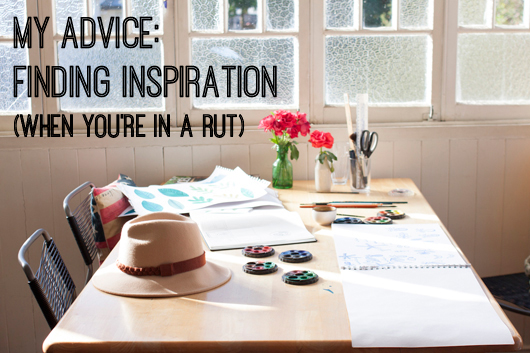
{Photo by Emily Nelson}
It seems fitting that it took me a while to get started on this introduction, and that in the meantime I had to get up and make a cup of tea. A creative rut can strike at any time, whether you're writing a blog post, starting a painting, composing a song or mere hours away from a client deadline. I asked an illustrator, painter, musician and creator how they find inspiration when they're having 'one of those days'.
Allow it.
Helen Franzmann, musician, McKisko
"I am stuck in a creative rut. I have been for some time. I've never been the kind of person who can turn songwriting on. I respond negatively to external pressures and I'm stubborn. I know what I need to do but sometimes the desert that is the rut becomes so consuming I avoid even picking up an instrument. So, to give advice on how to shift this is confronting for me because I'm in it and my biggest obstacle is myself.
Generally I... Allow it. Read. Look at art books and go to exhibitions. Draw. Play. Hang out with people that inspire me. Write in the mornings when I'm still a bit dream struck. Don't expect everything to become something. Actively listen. Take good notes. Avoid social media and internet wormholes.
Wish me luck."
Move, do and observe details.
Jade Suine, creator, Forget Cake
"Creative inspiration is a sum of everything I have taken in and the connections I make between it all; it sets me abuzz when it catches me off-guard but kick-starting creativity on cue can be oh-so daunting. There are 3 things that prove almost fool-proof for me however: moving, doing, and observing details.
Whether it’s walking to my day job in the morning and thinking of script ideas or scrawling notes while I’m on the train or in an aeroplane, I find the act of moving, or more so, going somewhere, to be very conducive to creating. During my creative thinking studies I’ve even had to admit that exercise helps. Perhaps while the primal part of our brain is ticking over in rhythmic motion other parts of our brain are free to produce the esteemed juice!
I also find that good ideas can become spectacular through doing; decent work can only grow into something sensational through actually making it. As hard as it can be to get started, iteration and experimentation are at the heart of creating, they are the framework, fuel and the fun part!
While doing all this moving, testing and doing, I try to make sure I observe. Exploring through my camera, sketching an amazing shape I see, noting down the something that can potentially be a starting point for the next project or a better version of what I’m already making."

Make a mess cleaning, tidy it, then go for a short walk.
Carolyn O’Neill, artist
"The act of starting on a painting can sometimes be daunting. I generally start one by cleaning out my paint bowls and making quite a mess, but it’s my starting point. When stuck for inspiration I might tidy up the studio, go for a short walk to clear my head, taking in the scenery around me. Coffee breaks are good too, as sometimes you just need to get out of the studio.
Quick sketches on paper also help as does swapping your dominant hand to paint or draw. Holding the end of the brush so you have less control and writing down thoughts and ideas can be useful. Background music can set the mood for inspiration."

Break the problem down into smaller steps.
Emily Nelson, illustrator
"Working from home and freelancing full time means that I have to stay motivated and switch my creative brain on even if I’m not in the mood. When I’m having trouble creating new work, I set up a nice clean space, a cup of tea, and maybe some music and write down all of the things that I like at the moment in a notebook. I write down objects, colours, descriptive words, themes, anything that I’m interested in. Then I find that ideas start to emerge from my lists and I can start to draw little sketches and form ideas for new art works. Sometimes if I’m really stuck, I look through old notebooks and pick up forgotten ideas. I also make cheesy, motivational art works and display them around my studio as a reminder to stick at it.
When I’m working on a commissioned project and I hit a creative brain freeze, it’s usually because something is challenging me. I often freeze up when my work becomes hard and I don’t know how to solve a problem. When this happens I always break the problem down into smaller steps and it becomes much easier to manage. For dealing with stress related brain freeze, I take a long walk in the morning before I start work and take tea breaks when my work gets tired, which helps me to regroup and find clarity. My brain gets cluttered and needs some space to think sometimes! It may sound like procrastination, but de-cluttering my studio really helps me to get into a creative mind set. My studio gets really messy during a project and when I’m finished I clean up and start fresh for the next project. And in the case of an emergency creative brain freeze, I jump in the shower. I usually come up with lots of ideas in there."

Lizzie Stafford is a freelance writer and editor and owns and runs Künstler, an independent magazine and bookstore based in Winn Lane, Brisbane. She is the Brisbane events coordinator for CWC.